
Quote Stories
A Blue Thread Through the Hill
Inez learns that a repair shop can mend more than shoes.

The red boot landed on Inez’s counter before the morning cable lift had made its second climb.
“Someone took the other one,” said the boy who carried it. “It was here yesterday.”
Inez looked past him at the shelf beside her workbench. It held buckles, laces, heel pieces, leather strips, and soles rescued from shoes whose owners had given up too soon. She had started the shelf to help customers make inexpensive repairs. Instead, it had become a wooden avalanche.
A black lace was tied around a brown buckle. Three left shoes leaned against a tin of buttons. A pair of boots sat beneath a handwritten note that said, simply, “Mine.”
“I didn’t take anything,” said a woman near the door.
“I didn’t say you did,” Inez replied, though her voice sounded sharper than she intended.
By noon, two customers were arguing over a boot. It turned out to be neither of theirs. Inez found the missing partner under a stack of bicycle tires, attached to a note that belonged to a pair of sandals.
She closed the shelf and locked it.
That evening, she counted the day’s receipts. The repair shop had earned enough to keep the lights on, but not enough to replace the worn awning before the rains. The shelf had cost her time, materials, and now the trust of two customers. For a moment, she considered throwing everything into the scrap bin.
Instead, she carried the boxes outside.
The next morning, she placed them in the alley and chalked a question on the wall: “How would you find your repair?”
The first suggestion came from Don Mateo, who repaired umbrellas. “Numbers,” he said. “One number per customer.”
“Numbers disappear,” said Lila, a school caretaker. “Use colors.”
A delivery cyclist proposed tags with drawings. A tailor suggested recording the shoe’s size. The boy with the red boot drew two red circles on a scrap of cardboard and labeled them “left” and “right.”
Inez listened, then built a new shelf with six painted sections. Green meant ready to use. Yellow meant waiting for a match. Blue meant someone had donated it. Red meant it was reserved. Every item received a tag with a number, a sketch, and the date it arrived.
The first week was not elegant. A green buckle was placed among the yellow ones. Someone wrote “large shoe” when they meant “large buckle.” A puppy chewed three tags and carried them into the stairwell.
But people began correcting the system instead of abandoning it.
Lila made a large-print ledger. Don Mateo fashioned metal clips from umbrella ribs. The boy with the red boot returned with his sister and learned how to punch holes in leather. Inez showed them how to soften a heel, stitch a torn seam, and tell the difference between a sole that needed replacing and one that only needed patience.
Soon, customers began bringing useful scraps from home. A shoemaker from the next alley offered leftover leather. A bus driver donated buckles from an old uniform stock. Inez set fair prices for repairs and a smaller price for parts from the shared shelf. No one received charity; everyone received choices.
By the start of the rains, the shelf had become three shelves, and the three shelves had become a cooperative. Each Saturday, two apprentices helped sort materials while Inez handled difficult repairs. The others kept the ledger, taught beginners, or collected pieces that might otherwise be discarded.
One afternoon, the boy with the red boot arrived wearing both boots. The repaired pair did not match perfectly. One had a dark red lace, the other a faded orange one.
“They’re different,” he said.
Inez examined the stitching. “They’re honest about it.”
He grinned and ran down the hill.
At closing time, Inez stood beneath the patched awning and watched the cable lift slide above the rooftops. Her shop was still modest. The rain still found the weak places. But the workbench no longer belonged to her alone, and neither did the useful things waiting to be made from what others had overlooked.
On the newest shelf, every tag had a place. So did every person who came through the door.
Related Quote Stories
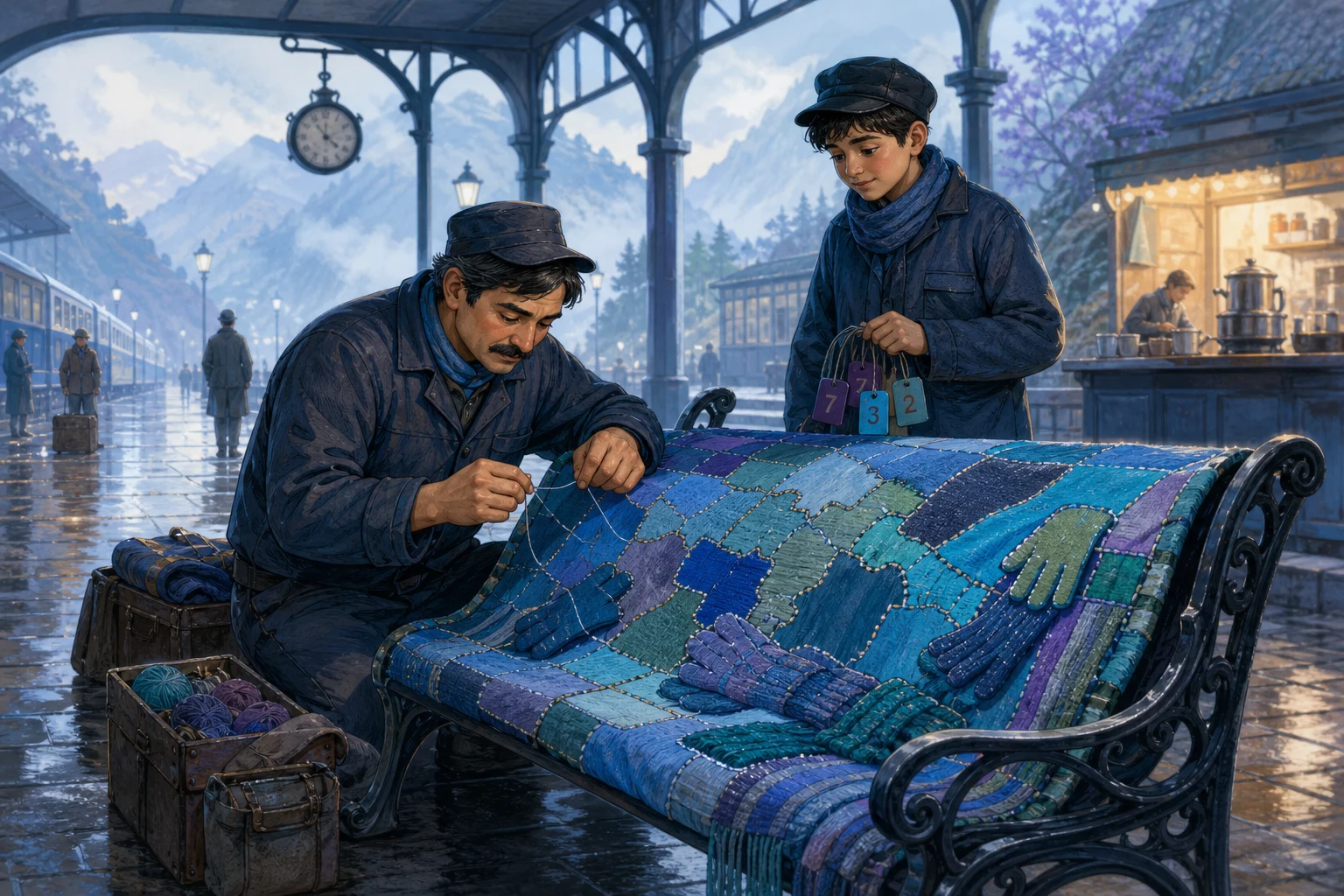
A Map Woven in Blue
Ilya’s patchwork bench covers began with lost gloves and ended as a map everyone could help complete.
Read Story →
Tabs in the Wind
Kito’s first calendar was neat, accurate, and almost useless. The second one belonged to everyone.
Read Story →
A Tune for Every Pocket
Celia could repair almost anything with a spring, a screwdriver, and enough patience. Her niece’s silence in music class required something different.
Read Story →