
Quote Stories
A Lamp Made of Many Winds
Kito’s brightest idea begins with a disappointing model.

The lamp flickered once, twice, and went dark.
Kito stared at the tiny windmill turning above the shed. Its four silver blades flashed in the afternoon sun, swift and graceful as swallows. Below, however, the reading lamp gave no more light than a firefly.
“Again,” Kito muttered.
He tightened the wire, shifted the axle, and waited for the wind rushing down from the red ridges. The blades spun faster. The lamp remained stubbornly dim.
The youth fair was three days away. Kito had imagined a blue ribbon, a photograph in the fair booklet, and his father telling every customer that the model had been built by a clever son.
Instead, he carried it to Nima, the potter, who examined the blades with clay-dusted fingers.
“They are handsome,” she said. “But perhaps they are trying too hard to catch the wind.”
At the repair shed, Boro the bicycle mechanic replaced Kito’s delicate gear with one from an old bell. It made the windmill lurch, squeak, and finally fling a blade into a basket of nails.
Kito wanted to hide the whole project beneath a blanket.
Then his younger cousins found the broken model.
“Can we make one?” asked Sela.
“Not this one,” Kito said.
“Why not?”
He looked at the dark lamp. He looked at the scattered blades. The answer he had prepared—because it is mine—sounded smaller than it had a moment before.
“All right,” he said. “But we test everything.”
They built a second windmill from reed strips, a third from thin tin, and a fourth with six broad wooden blades. None worked perfectly. The reed model turned gently enough to lift a paper flag. The tin model produced a brief bright flash. The wooden one powered a little buzzer but shook itself apart.
Kito began keeping notes. Sela drew pictures beside the numbers. Nima shaped a clay housing for the axle. Boro adjusted the gears and taught the cousins how to listen for a useful hum instead of a noisy scrape.
By the morning of the fair, Kito’s table held five windmills. One lit the lamp. One rang the buzzer. One turned a small fan. Two were still being repaired.
A judge asked which model was the best.
Kito glanced at the children gathered around the table. Sela was explaining the paper-flag test to a boy who had just arrived. Nima was showing a teacher how the clay housing kept dust from the axle. Boro was laughing as the six-bladed windmill wobbled in a circle.
“They are best at different things,” Kito said. “Would you like to try them?”
Soon the fair table became a workshop. Visitors changed blades, counted turns, and made predictions. The lamp glowed, went dim, and glowed again as new hands tested new ideas.
Kito did not win the blue ribbon. He received a smaller card for “Useful Demonstration,” which he tucked carefully into his pocket.
That evening, the original windmill stood above the shed. Its smallest blade, shaped by Sela from a scrap of reed, caught the last breeze and sent a warm circle of light across the pages of Kito’s book.
He read beside his cousins while the little machine turned overhead—not proving who had been cleverest, but giving everyone another question to ask.
Related Quote Stories

When Desks Learned to Bend
Nera’s first folding desk collapsed under the weight of a single book. Hiding the failure would be easy; inviting others to inspect it would be harder—and far more useful.
Read Story →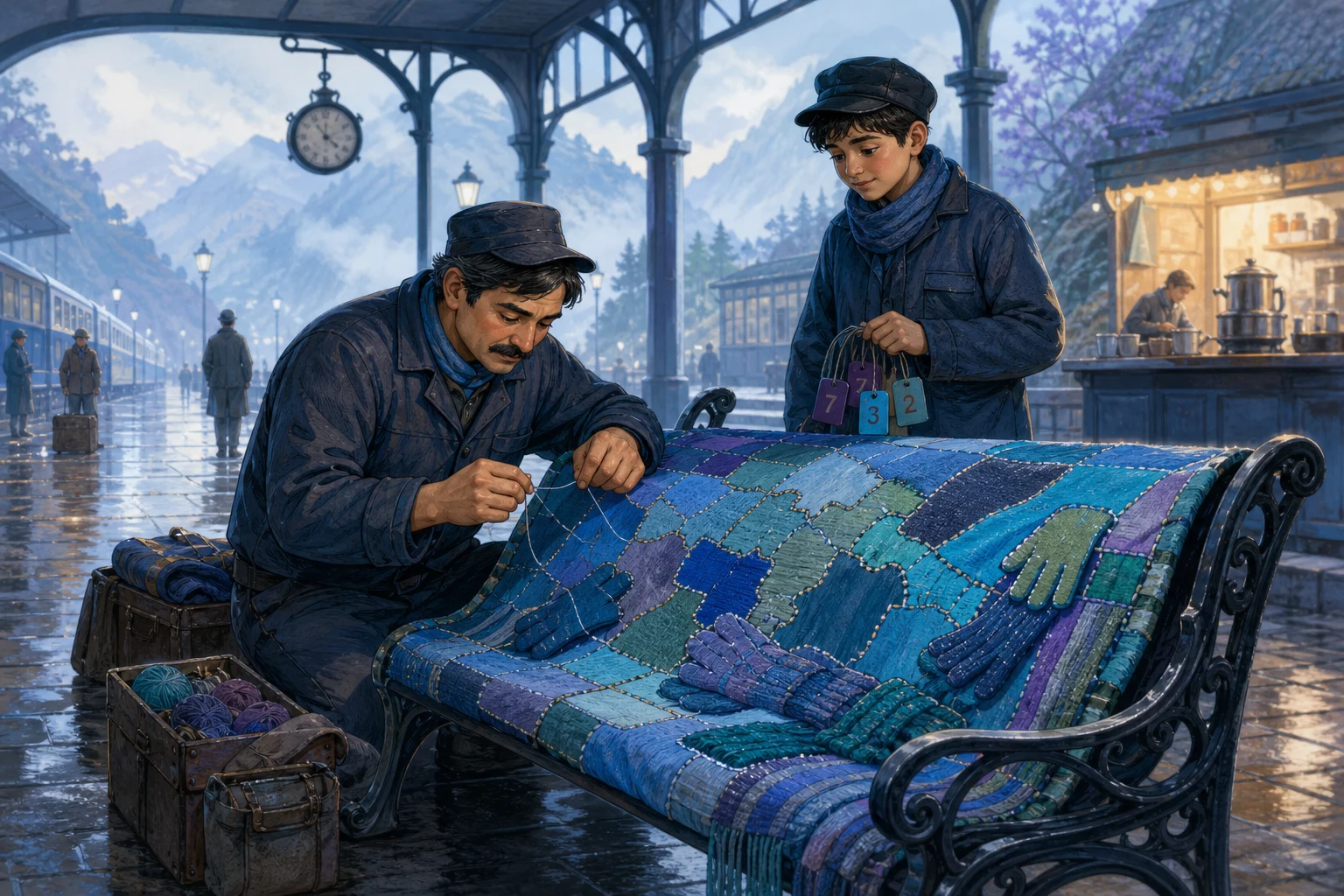
A Map Woven in Blue
Ilya’s patchwork bench covers began with lost gloves and ended as a map everyone could help complete.
Read Story →
The Hour Nobody Owned
Mina’s first community hour is lively, crowded, and almost entirely controlled by the loudest guests. A ferry cleaner, a brass token, and one patient adjustment teach her what true hospitality requires.
Read Story →