
Quote Stories
After the Last Train
A café manager learns that welcome cannot be printed on a discount card.
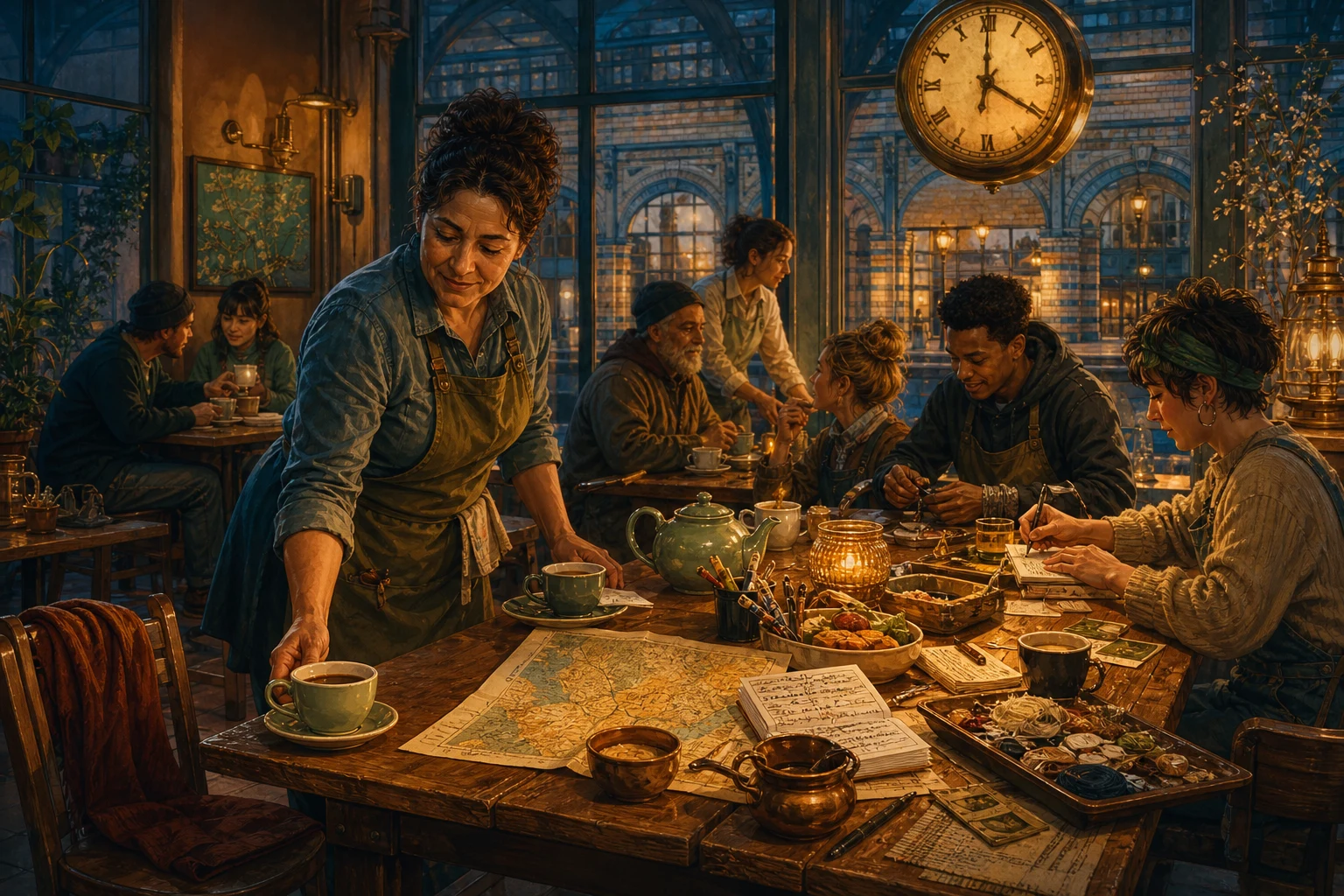
The discount cards were stacked beside the till, each one stamped with a neat blue circle.
“Apprentice rate,” Oren announced, sliding the pile toward the evening server. “Ten percent off any meal after seven.”
The server glanced through the café’s wide front window toward the tiled station arcade. Three young workers in dusty jackets stood beneath the clock, studying the menu as if it were a transit map. One pointed. Another shook his head. Then they moved on.
Oren had noticed the pattern for weeks. New apprentices from the repair shops and carriage yards came in after their shifts, hovered near the door, and left without ordering. The café had rules no one had written down: where regulars sat, when to join a table, which jokes required an answer, how long one could occupy a chair with only tea.
He believed a clear policy would solve the problem.
It did not.
The next evening, Oren offered the cards to two apprentices. They accepted them carefully, as though the blue circles marked them for inspection. They ordered the cheapest tea, sat at the smallest table, and left before the cups cooled.
That night, while stacking chairs, Oren found one card tucked beneath a saucer. On the back, someone had drawn a maze.
The following week, he changed one thing. After the dinner rush, he left the long table beneath the brass railway clock unreserved. He placed a pot of tea in the middle and set out a small slate:
Bring a question. Leave an answer.
At first, the table looked foolishly empty. Oren polished the same sugar bowl three times. Then Mira, a regular who repaired clocks, sat down with a pencil and wrote: “How do you read the platform numbers?”
A young apprentice named Sava answered by drawing arrows through the station map. In return, Mira showed Sava how to tell whether a clock was losing time by listening to its second hand.
The next night, someone added a recipe for lentil cakes. Someone else wrote three ways to pronounce a greeting. A delivery rider explained how to prepare for an interview without memorizing every answer. Oren contributed the only skill he thought he had: he taught everyone how to carry six cups without losing the seventh.
“Your method is mostly confidence,” Mira observed.
“Confidence and dry floors,” Oren said.
Soon the table filled after closing. People arrived with questions, tools, scraps of paper, and stories that did not fit on the café menu. Oren stopped hovering. He learned that Sava could repair a stubborn hinge, that Mira knew songs from four neighborhoods, and that the apprentices had been teaching one another the city’s unwritten routes.
Then the café’s annual food night arrived.
Oren had planned it for months: twelve dishes, four seating times, numbered tickets, and a printed diagram showing exactly where every plate should go. By seven-thirty, the diagram had become confetti. A tray of pastries landed at the soup table. Two cooks argued over labels. Guests crowded the entrance while the long table filled with people who had not reserved seats.
Oren stood behind the counter, holding three menus and no idea what to do first.
Sava climbed onto a chair.
“Move the sweets beside the window!” she called. “Mira, can you make two more signs? In three languages, please. You—take these bowls to the back room. No, not that door; the latch sticks.”
The apprentices took over without waiting to be invited. Regulars followed their directions. A tailor lent folding stools. The delivery rider drew a new seating map on butcher paper. Someone opened the long table to families who had arrived late, and someone else began explaining each dish to guests who had never seen it before.
By closing time, every plate was gone. The café was untidy, warm, and louder than Oren had ever heard it.
He found Sava at the long table, adding a new line to the slate.
“What are you writing?” he asked.
She turned it toward him.
“Leave a place for the person who has not arrived yet.”
Oren looked at the empty chair beside her. For once, he did not calculate its value by the hour.
He brought another cup, set it down, and left the chair unreserved.
Related Quote Stories
A Pocketful of Repairs
When a delivery rider brings Mara a jacket held together by mismatched buttons, the retiring tailor begins one last project: teaching the whole district how to mend what still has life in it.
Read Story →
Lanterns Between Currents
Isha measured every delivery in minutes—until the dark paths between the market stalls taught her that getting somewhere mattered less than helping others find the way.
Read Story →
Hinges in Winter
Anja inherits a repair shed she intends to close, but a broken gate—and a child’s careful drawings—opens a different future.
Read Story →