
Quote Stories
Ash Glaze, Open Hands
Mara’s final firing reveals an unexpected way forward.
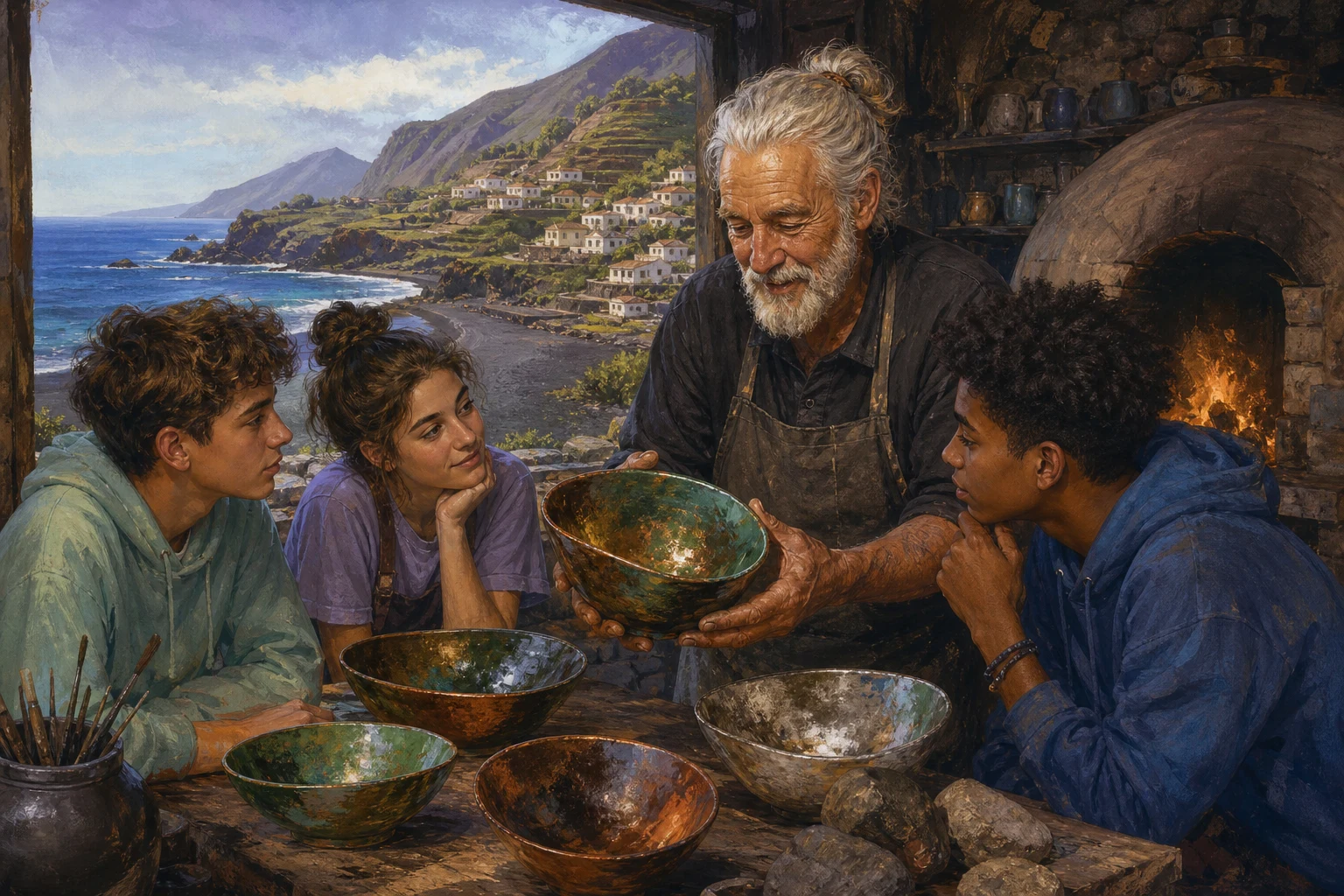
The bowls came out of the kiln leaning toward one another.
Mara lifted the first with both hands. Its rim had sagged into a soft wave, and the blue glaze had broken into green, copper, and a narrow streak of silver. The second bowl was flatter on one side. The third had a thumb-sized patch the color of storm clouds.
“Ugly,” she said.
Outside the workshop, the sea struck the black-sand shore below the village. Heat shimmered above the kiln roof. On the wall, Mara’s closing date was written in white chalk: LAST MARKET, THREE WEEKS.
A pebble tapped the open window.
“Mara?” called Sela. “Are you throwing those away?”
Sela stood below with Iven, Tomas, and Neri, all carrying sketchbooks and the uncertain expressions of people who had come hoping not to be sent home.
“I might,” Mara said.
“Can we see them first?”
Mara almost said no. For forty years, she had decided what belonged on a table and what belonged in the clay bin. But the silver streak on the first bowl caught the light again, and she found herself setting it down instead of dropping it.
The teenagers crowded around the workbench.
Iven turned the bowl slowly. “It looks like the cliff after rain.”
“It looks like the kiln misbehaved,” Mara replied.
“Those could be the same thing,” said Neri.
Mara gave them each a piece of scrap clay. If they were going to admire mistakes, she decided, they could learn how difficult it was to make one.
For three afternoons, they tested glazes. They mixed ash from different trees, crushed red mineral from the upper slopes, and powdered shells gathered near the fishing sheds. Mara taught them how to keep notes, how to mark the thickness of a coat, and how to listen for the kiln’s changes in pitch as the fire climbed.
The work was slow. One test came out the color of dishwater. Another blistered. A third fused to the shelf.
Mara reached for the hammer.
“Wait,” said Sela. She held the ruined tile near the window. “The bubbles only formed where the glaze was thick.”
Mara stopped.
They compared every tile. The young makers drew grids across their pages. They measured the kiln shelves, recorded the wind direction, and placed small clay markers at different heights. Mara, who had trusted her hands more than paper for most of her life, began keeping a notebook beside them.
On the next firing, the bowls still came out uneven. But the unevenness had become predictable. A shallow dish placed near the back wall took on a deep green edge. Cups on the upper shelf developed silver flecks. A thin coat of ash glaze, applied with a rough brush, made each piece look as though a wave had passed over it.
Mara stared at the results.
“We can do it again,” Tomas said.
“Not exactly,” Mara answered. “But close enough to make a family.”
They called the pattern Tidework.
At the final market, Mara carried out a long table of bowls, each one slightly different. A fisherman bought six. A baker bought twelve. Visitors ran their fingers over the raised rims and asked who had made them.
Mara pointed toward the teenagers, who were arguing cheerfully over the order of the next firing.
“Those hands,” she said. “And mine, for now.”
That evening, she removed the chalk date from the wall. Beneath it, she wrote a new one: FIRST OPEN WORKSHOP.
The kiln cooled behind her, holding its heat for tomorrow.
Related Quote Stories

Wind Has Opinions
Eren wanted the festival record. Then the wind tore his masterpiece apart and gave him a better challenge: design something that could belong to everyone.
Read Story →
What the Hillside Knew
When her first planting failed, soil surveyor Amara traded certainty for questions—and found the hillside already had teachers.
Read Story →
Light Finds a Way
Beni wanted applause. What he found beneath the hall’s floorboards was something better: a way for many hands to make the evening shine.
Read Story →