
Quote Stories
Built to Drift
Edda’s fastest lesson begins with an old hull and ends beyond the finish line.
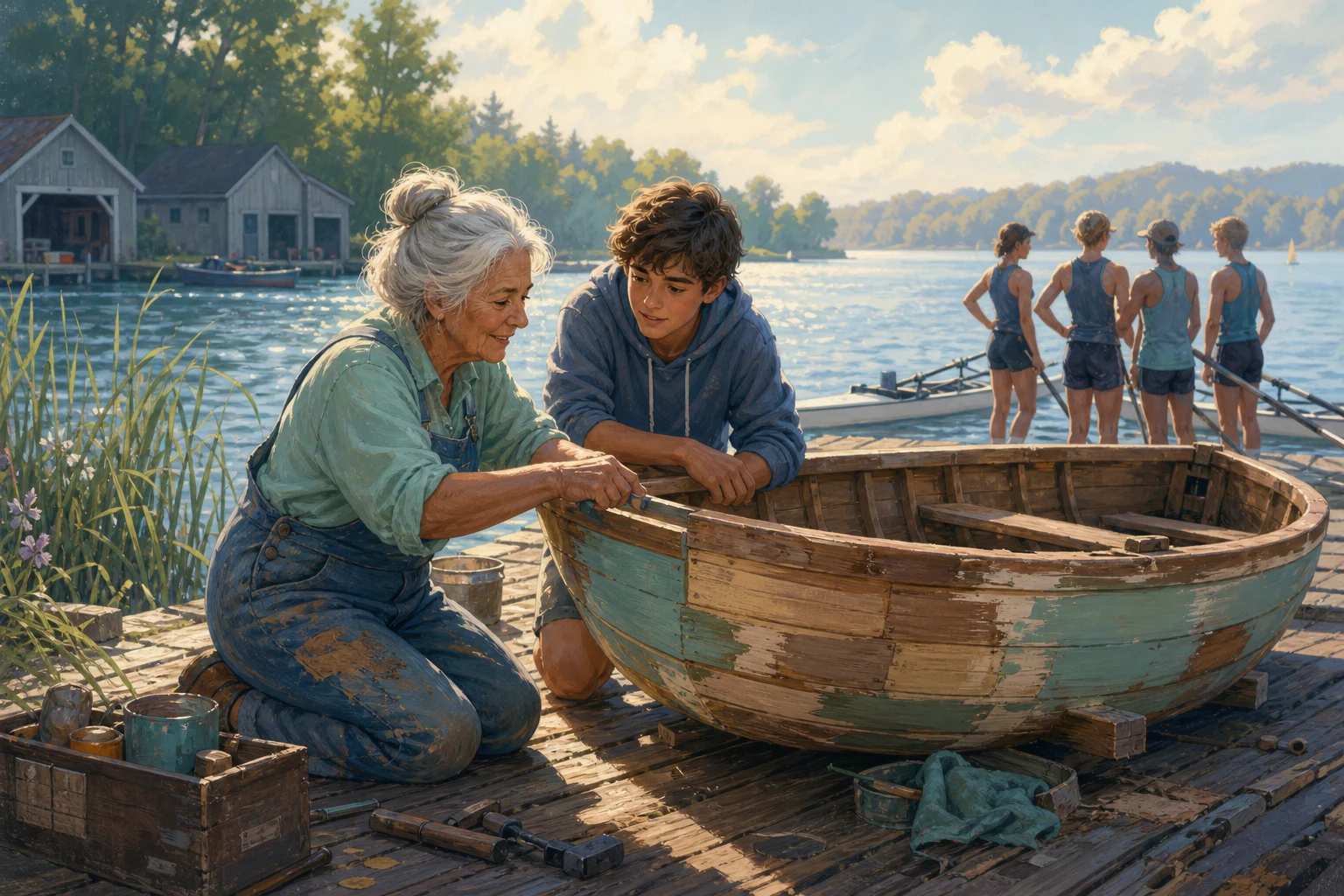
Edda set the cedar rib on the workbench and slid a pencil toward Niko.
“Trace it,” she said.
“Why? We already know what shape it is.”
“If you already know, you’ll make the same mistake twice.”
Niko glanced at the regatta calendar pinned above the stove. Thursday was circled in red. The youth races were five days away, and he had promised his friends a boat quick enough to leave their rivals staring at its wake.
The skiff in Edda’s shed had belonged to a school club years ago. Its paint was the color of weak tea, its oarlocks were mismatched, and one side of the hull had a long, thoughtful crack.
“It looks tired,” Niko said.
“So do I. I still float.”
He tried not to smile. Edda noticed anyway.
They stripped the old boat to bare wood. Niko measured every curve twice and complained that the hull was too narrow at the stern, too heavy in the middle, and entirely wrong for racing.
Edda answered each complaint with a question.
“What would you change?”
“Everything.”
“Good. Start with one thing.”
By Tuesday afternoon, they had replaced two ribs, widened the seat, and discovered that the crack ran farther than either of them had seen. Niko dropped his screwdriver into the bilge.
“We can’t finish this by Thursday.”
“We can finish something by Thursday.”
“That isn’t the same.”
“No,” Edda said. “It usually isn’t.”
The next morning, she carried the hull down to the club dock. Three young rowers were practicing nearby, splashing more than they pulled. Niko expected Edda to tell them to keep away from the work.
Instead, she called, “Who wants to sit in it?”
Soon the boat was full of opinions. One rower said the seat pinched. Another thought the oars were too long. A quiet girl named Sella shifted her weight an inch and made the hull settle level in the water.
Niko watched the boat respond.
“What did you do?” he asked.
“Nothing,” Sella said. “I stopped fighting it.”
That afternoon, they shortened the oars, moved the foot brace, and added a small strip of cedar along the damaged side. Niko made a chart of each adjustment. Edda pretended not to be impressed until he caught her copying the chart into her notebook.
On Thursday, the skiff reached the starting dock with its new paint still shining unevenly. It was not the fastest boat in the regatta. Niko knew that before the first stroke. The hull settled low, and the patched side made a faint clicking sound whenever the water turned choppy.
They finished last in their heat.
For a moment, Niko kept rowing after the finish rope, his face hot beneath the sun. Then he heard someone on the dock call, “Can we use it next?”
The club’s younger rowers had gathered beside Edda. Sella was holding the shortened oars. A beginner wanted to try the wider seat. Someone else had already brought a rag for the hull.
Niko rested his hands on the oar handles.
“It’s slow,” he said.
Edda looked at the boat, then at the waiting rowers.
“Slow is not the same as finished.”
Niko glanced toward the bright racing shells slicing across the lake. Then he turned the skiff toward the dock.
By the end of the afternoon, everyone had taken a turn. The boat tipped, steadied, and carried them back each time. Niko kept the chart, but he left the final column blank.
“What belongs there?” Edda asked.
He considered the question. “What we haven’t learned yet.”
Edda nodded and handed him the pencil.
The old hull rested at the water’s edge, ready for tomorrow’s first lesson.
Related Quote Stories

A Chorus of Small Bells
When the old bell molds crack, ceramicist Tavi tries to save the town’s procession by designing every replacement herself. The bells only find their music when she makes room for everyone else.
Read Story →
Chain Reaction
Daro wanted the hill race to prove he was the fastest mechanic in the club. Then his chain snapped, and the finish line began to look different.
Read Story →
When the Harbor Hums
A night-shift harbor dispatcher opens an unused ferry room for dockworkers’ children, then discovers that the strongest welcome is one the visitors help build.
Read Story →