
Quote Stories
Canvas Between Stops
Amel learns that a useful idea needs more than one pair of hands.

Amel’s first shade canopy lasted eleven seconds.
At the twelfth, one corner sprang loose, the cloth snapped like a sail, and the whole arrangement folded over a pyramid of melons. The vendor caught three before they rolled into the street.
“Good canopy,” he said, examining the wreckage. “If the goal is to shade the fruit.”
Amel, still holding a bicycle pump in one hand and a length of rope in the other, looked toward the market’s far end. The afternoon sun had turned the paving stones white. Couriers leaned against walls between deliveries. Street sweepers drank water beneath handcarts. Commuters stood wherever a narrow strip of shadow touched the ground.
She had noticed the problem for weeks. She had also assumed the solution would be quick.
That evening, Amel spread retired advertising cloth across the floor of her aunt’s rooftop workshop. The cloth was bright with faded letters and arrows pointing toward businesses that no longer existed. She cut panels, stitched pockets, and made wooden ribs from discarded packing crates.
The next morning, she carried six versions to the market.
Instead of saying, “I made this,” she asked, “Where would you put it?”
The melon vendor wanted shade that could be lifted with one hand. Salma, who swept the arcade before sunrise, needed a panel that would not catch on her broom. A tramless-street courier—who carried parcels by handcart—wanted a narrow tunnel between two stalls. The bread seller wanted somewhere his apprentice could sit without blocking customers.
Every answer changed the design.
The panels became lighter. Their feet widened. A blue cord meant “please leave this passage clear.” Small cloth loops allowed two neighboring stalls to join their shade without tying anything to a cart. Amel printed no instructions; she painted simple pictures instead.
Then the heat arrived.
By midday, the market was crowded and strangely quiet. People moved from shadow to shadow, carrying baskets close to their bodies. A delivery boy stumbled beside the spice stalls. Before Amel could reach him, Salma opened the nearest panel. The melon vendor added another. A flower seller brought out two more from behind her counter.
“Not there,” Salma called. “The next patch is needed by the water jars.”
The workers began moving the panels in sequence. One shade led to another: beside the bread stall, past the stacked rugs, around the fountain, and toward the loading lane. The route shifted as the sun moved. People learned the pattern quickly. A child held a cord aside. A commuter carried a wooden foot. Someone found a missing pin in a pocket and returned it without being asked.
Amel stood at the center, trying not to direct everyone.
“Where should this one go?” she asked.
The answers came from all sides.
By evening, the market had made a shaded path longer than any single stall could have managed. The retired cloth glowed amber in the lowering light, its old advertisements broken into bright fragments across the ground.
A week later, Amel cleared a corner of the rooftop workshop. The market workers arrived with measurements, repaired frames, and a list of places that needed covers: the water queue, the public benches, the loading steps, the school crossing.
They named their little workshop Sunfold. Amel handled the stitching, but nobody called it her business. The vendors tested each new panel. Sweepers checked its hinges. Couriers carried prototypes over uneven streets. The people who used the shade helped decide how it should stand.
On the first cool morning of autumn, Amel cycled through the market without stopping. Above her, panels opened one after another, making a moving ribbon of shelter between the stalls.
The shade did not belong to anyone.
That was why it reached everyone.
Related Quote Stories

When Desks Learned to Bend
Nera’s first folding desk collapsed under the weight of a single book. Hiding the failure would be easy; inviting others to inspect it would be harder—and far more useful.
Read Story →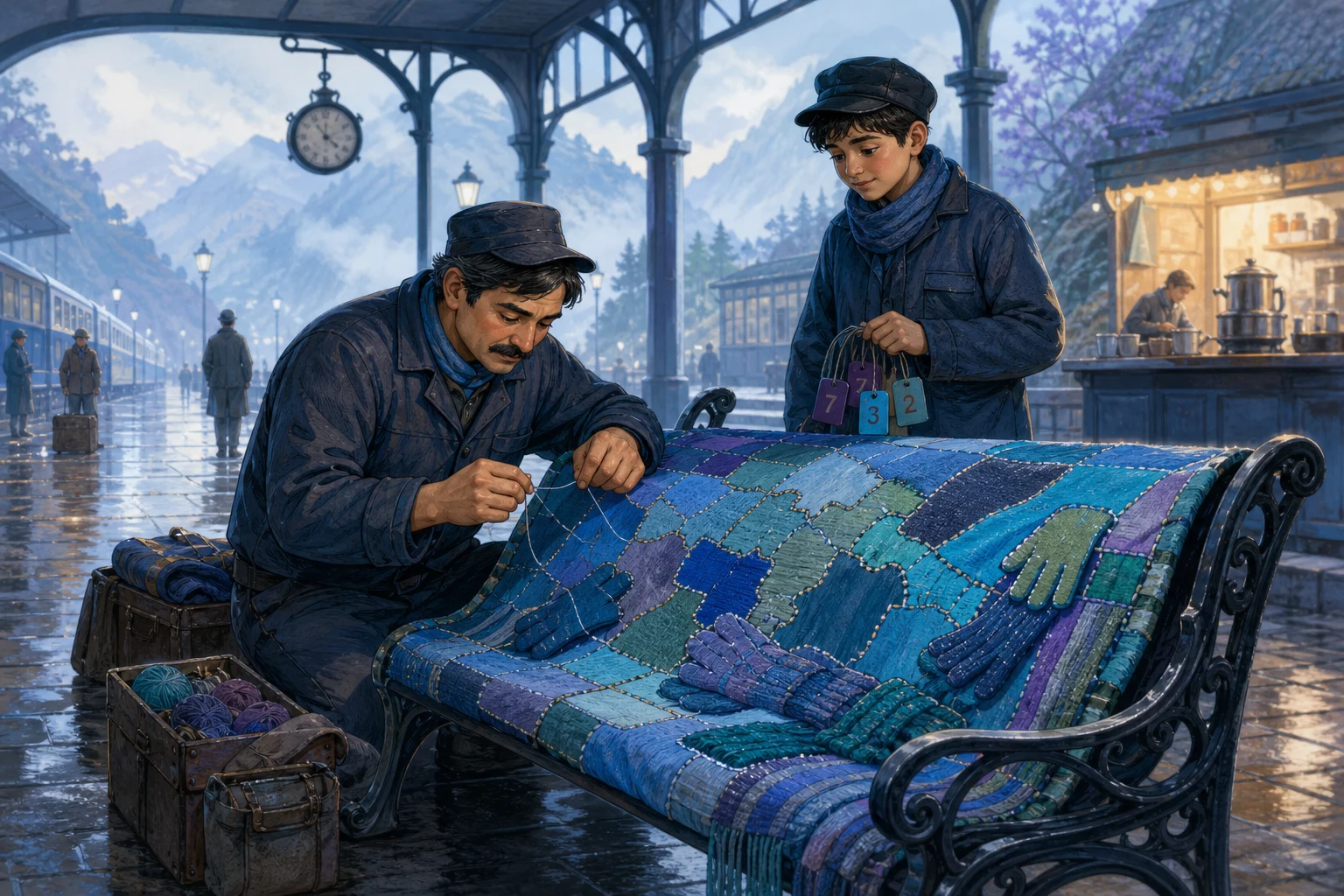
A Map Woven in Blue
Ilya’s patchwork bench covers began with lost gloves and ended as a map everyone could help complete.
Read Story →
Tabs in the Wind
Kito’s first calendar was neat, accurate, and almost useless. The second one belonged to everyone.
Read Story →