
Quote Stories
Instructions for a Windy Day
A caretaker redraws the path from hesitation to confidence

Mara found the abandoned shelf behind a stack of salt-stained winter boots.
Its boards were still good. The brackets were sturdy. The instruction sheet, however, looked like it had been designed by someone hiding from the alphabet.
She carried it to the apartment office and pinned it beside the laundry schedule. By lunchtime, three residents had added notes.
“Which way is the wall?” asked Mr. Dalen from 2B.
“Why are there six kinds of screws?” wrote Asha, who wanted a window box.
“Is this bicycle stand supposed to lean?” wondered Tomas, in a message accompanied by a photograph of a very crooked stand.
Mara, who had spent eight years repairing loose handles, sticking windows, and coaxing ancient radiators through winter, understood the problem. People were not refusing to improve their homes. They were being asked to translate a language they had never learned.
That evening, she drew a new instruction sheet. A smiling screw pointed toward a smiling bracket. Arrows showed where hands belonged. A tiny warning triangle wore a hat.
The next morning, the shelf stood level in the hallway.
Mara drew another guide. Then another. Soon the office wall held a cheerful collection: “How to Hang a Window Box Without Losing the Window,” “Bicycle Stand: Straight Is a Direction,” and “Three Ways to Tell Which End of the Tape Measure Is Lying.”
Residents began leaving unfinished projects outside her door.
Mara liked the diagrams because they did not require her to make conversation. But the projects created a new problem. Everyone owned one hammer, one screwdriver, or one wrench, and nobody knew who was willing to lend what.
So Mara proposed a shared tool cabinet at the tenants’ meeting.
“It sounds useful,” said the committee chair, “but tools can be dangerous. Things get broken. People forget to return them.”
Mara felt her proposal fold inward, like a paper fan.
On her way home, she passed Tomas wrestling with the crooked bicycle stand. He had built it twice and still could not make it hold a wheel.
“Would you show me where it went wrong?” Mara asked.
He blinked. “You mean, you don’t know?”
“I know several possible wrong places.”
They spent twenty minutes measuring the pavement. The stand was fine. The ground was sloped.
Tomas laughed so hard he had to sit down.
The following Saturday, Mara placed four tools on a folding table beneath the apartment awning. Beside them she set out her drawings and a sign: TRY BEFORE YOU BORROW.
Asha tested the drill on scrap wood. Mr. Dalen practiced tightening a clamp. Tomas, who knew more about tools than he admitted, demonstrated how to steady a board with his knee.
Nobody broke anything except one piece of scrap pine, which Mara labeled “successful evidence.”
The next week, they tested hinges. Then wall anchors. Then the mysterious art of finding a stud without knocking loudly enough to alarm the neighbors.
Each lesson added a new teacher. A retired tailor showed everyone how to mark a straight line with thread. A father who had once built theater sets explained leverage using a broom and a bucket. Tomas arrived early and arranged the tools by size.
At the next committee meeting, Mara placed a small notebook on the table.
Inside were names, tools, return dates, and a page titled THINGS WE LEARNED THE HARD WAY.
The committee approved the cabinet, provided that every borrower signed the notebook and attended one demonstration before taking a power tool home.
By spring, the apartment grounds had window boxes, repaired benches, two sturdy bicycle stands, and a gate that no longer dragged in the wind. Mara’s diagrams appeared everywhere, but they were no longer hers alone. Residents added translations, jokes, larger lettering, and pictures for people who preferred not to read instructions.
At the first warm-weather gathering, the committee asked Mara to explain how the tool library worked.
She stood beside the cabinet with her notes in hand. For a moment, the old quiet returned—the one that made every sentence feel like a loose screw.
Then Tomas raised the crooked bicycle stand like a trophy.
“Tell them about the slope,” he called.
Mara smiled and set down her notes.
“The first rule,” she said, “is that the instructions may be wrong.”
Everyone leaned closer.
“The second is that if something doesn’t make sense, you don’t have to struggle alone. You can ask, test, redraw, and try again.”
Behind her, the cabinet door swung open in the prairie wind. Inside, every tool had a label. On the wall beside it, someone had posted a fresh diagram: two hands passing a wrench from one person to another.
Related Quote Stories

When Desks Learned to Bend
Nera’s first folding desk collapsed under the weight of a single book. Hiding the failure would be easy; inviting others to inspect it would be harder—and far more useful.
Read Story →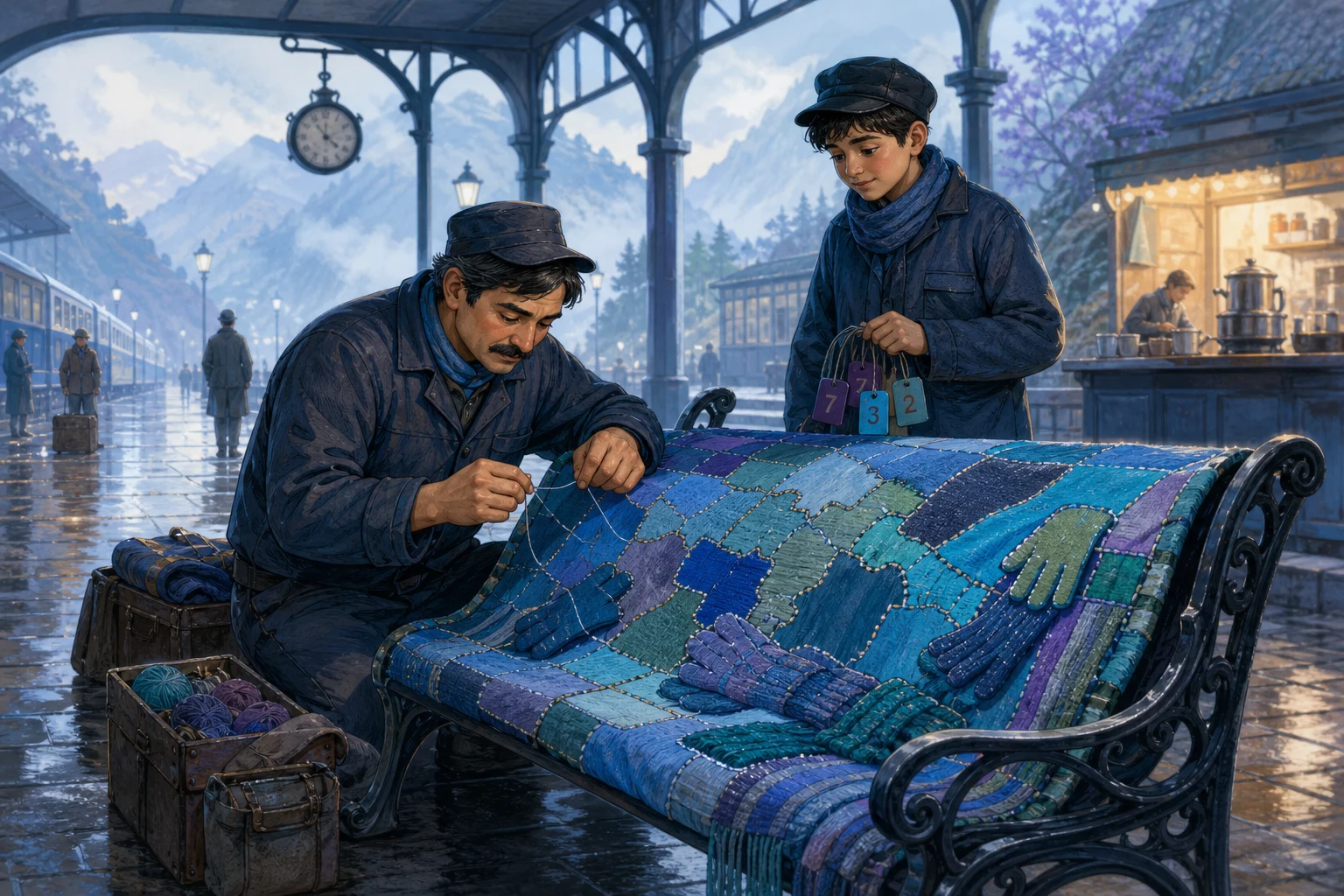
A Map Woven in Blue
Ilya’s patchwork bench covers began with lost gloves and ended as a map everyone could help complete.
Read Story →
The Hour Nobody Owned
Mina’s first community hour is lively, crowded, and almost entirely controlled by the loudest guests. A ferry cleaner, a brass token, and one patient adjustment teach her what true hospitality requires.
Read Story →