
Quote Stories
Paper Learns the Wind
A careful apprentice discovers that a tradition can survive by changing shape.

Mina had repaired forty-three kites before admitting that the wind was not the problem. Her instructions were.
She stood behind the counter of Bell & Reed Paper Goods, holding the latest wreckage by its bamboo spine. Outside, spring wind rushed along the river embankment, lifting dust from the terraces and snapping laundry on the roofs. Inside, a painted notice announced the Kite Day that would not happen.
Caro Bell, Mina’s employer, had taken down the festival bunting that morning. The organizer had moved away, and nobody else knew how to arrange the contests, stalls, music, and hundreds of flying shapes.
“I can restore it,” Mina said.
Caro glanced at the collapsed kite. “Restore what?”
“The festival.”
For a week, Mina followed the old instructions exactly. She measured the tails, copied the traditional diamond pattern, and used the same thin paper named in the ledger. Every kite rose beautifully for three seconds before folding in the middle and sailing into a hedge, a chimney, or once, spectacularly, into a baker’s basket of rolls.
At the embankment, retired mapmaker Orin Vale watched another kite tumble into the grass.
“You’re drawing yesterday’s wind,” he said.
Mina frowned. “Wind doesn’t change that much.”
Orin pointed toward the river. “The river does. The fields do. The roofs do. A map that refuses to change becomes a lie.”
He did not tell her how to fix the kite. Instead, he lent her a bundle of blank cards and suggested she ask people what they remembered.
Mina expected instructions. She received stories.
A farmer remembered kites shaped like sickles because they turned neatly above the terraces. A boat repairer described a broad-winged bird that could hover over the water. The schoolchildren remembered only that everyone used to laugh when the mayor’s kite landed in a tree.
Then three younger children arrived at the shop carrying leaves, twine, and a bent wooden spoon.
“We want to make a kite like this,” said Tavi, holding up the spoon.
“It’s not symmetrical,” Mina said.
“That’s why it can turn,” Tavi replied.
Mina almost corrected him. Instead, she reached for paper.
The children’s designs filled the worktable: a heron with one deliberately crooked wing, a leaf with a long curling tail, a farm tool that looked more like a dancing insect. Mina tested each one. Some spun. Some dragged. One rose backward and landed on Orin’s hat.
He bowed beneath it.
By the festival morning, Mina had stopped trying to recreate the old display. She hung a new sign on the embankment:
BRING A SHAPE THE WIND HAS NOT SEEN.
There were no official contests. People flew what they had made. The baker sent up a golden crescent. The boat repairer launched a blue fish that dipped toward the river without touching it. Caro Bell, who claimed not to be artistic, built a square kite that rose steadily above the crowd.
Mina kept the original diamond kite folded under her arm. Near sunset, Orin found her watching the sky.
“You could fly it,” he said.
“It still won’t work.”
“Perhaps it worked for the person who made it.”
Mina studied the old kite. Its paper was faded, its frame too rigid for the valley wind. She loosened one crosspiece, added a narrow tail, and handed it to Orin.
Together they ran toward the river.
The kite climbed—not high, not gracefully, but high enough. Below it, dozens of new shapes tugged at their strings, each answering the wind differently. The old diamond wobbled among them, no longer a model to copy or a failure to hide.
Mina smiled as it steadied.
“Next year,” Tavi called, “we’ll make something stranger!”
Mina looked at the crowded sky and tightened her grip on the spool.
“Good,” she said. “We’ll need new instructions.”
Related Quote Stories
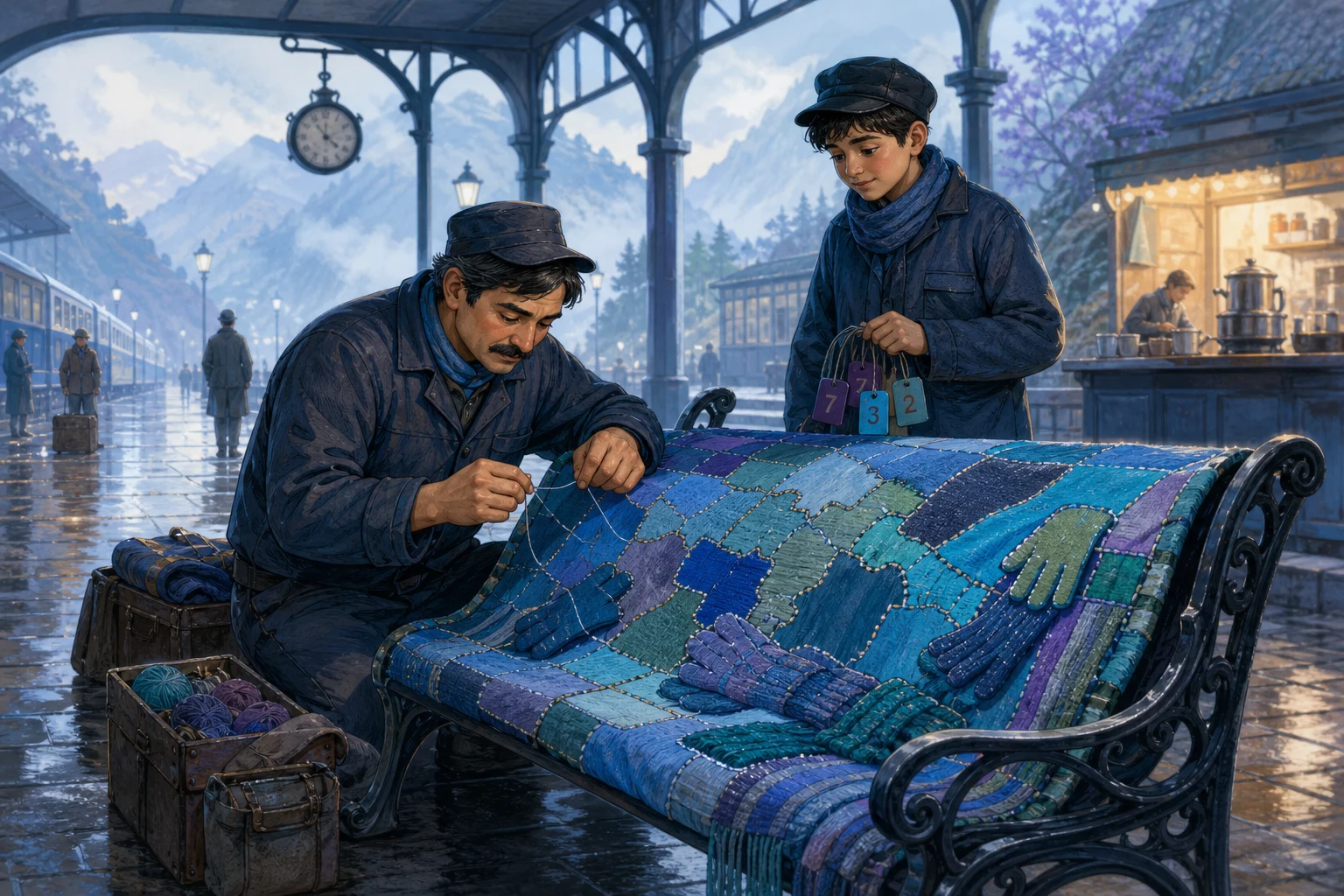
A Map Woven in Blue
Ilya’s patchwork bench covers began with lost gloves and ended as a map everyone could help complete.
Read Story →
Tabs in the Wind
Kito’s first calendar was neat, accurate, and almost useless. The second one belonged to everyone.
Read Story →
A Tune for Every Pocket
Celia could repair almost anything with a spring, a screwdriver, and enough patience. Her niece’s silence in music class required something different.
Read Story →