
Quote Stories
Rain Finds Its Quiet Place
A young apprentice learns that good design begins below the roofline.

The first drop struck the courtyard basin like a pebble tossed by an impatient child.
The second struck harder.
By the time Nara looked up from her calculations, rain was drumming across the library’s new roof and pouring through its metal gutters in four silver ropes. Each rope landed in the courtyard with a metallic boom. The sound bounced off the tiled walls, rattling the windows and scattering the children gathered for afternoon reading.
Librarian Sefa closed her book. “Everyone to the west room, please.”
A dozen children carried their cushions inside. One boy tucked his fingers into his ears.
Nara opened her notebook. “The outlet angle is wrong. I can fix it.”
“Tomorrow?” asked Sefa.
“Before tomorrow.”
That evening, Nara showed the measurements to her supervisor, Bako, at the rainwater cooperative’s workshop. He studied the page while a fan pushed warm air through the room.
“Add a splash guard,” he said. “Short job. Cheap job. No need to redesign the whole roof.”
Nara felt relieved. A quick answer suited her. Numbers did not argue, change their minds, or ask what the courtyard ought to become.
But the next morning, the vendors outside the library argued about the proposed fix.
“A louder splash guard will frighten customers away,” said Pema, who sold coconut buns beneath the awning.
“It should drain toward the mango tree,” said a gardener.
“It should drain toward the street,” said a porter. “The courtyard is already crowded.”
Sefa folded her arms. “And the reading group needs quiet.”
Everyone had a solution. Nobody had listened to the others.
Nara almost returned to her notebook. Instead, she placed a row of empty jars beneath the gutters.
“What are those for?” Bako asked.
“Evidence,” she said.
For three afternoons, the library users recorded the rain. Children tapped rhythms on paper whenever the drops grew louder. Sefa noted which lessons were interrupted. Pema marked where customers slipped. The gardener sketched the paths water took across the paving stones. Even the porter admitted that the courtyard filled fastest near the eastern wall.
Nara made charts, then made new charts when the charts failed to explain why the children preferred one corner over another.
On the fourth day, she finally asked.
The children wanted a place where they could hear pages turn. Pema wanted water that would not splash flour onto her baskets. The gardener wanted to grow herbs. The porter wanted a clear path for carts. Sefa wanted the courtyard to remain a place for people, not merely a pipe’s endpoint.
Nara returned to the workshop and erased her splash-guard design.
Bako watched her. “That was a perfectly good fix.”
“It fixed the roof,” Nara said. “Not the courtyard.”
Together, they built a stepped channel from glazed tiles reclaimed from the cooperative’s storage yard. Water would travel down three shallow terraces, each planted with herbs and rain-loving flowers, before entering a stone basin lined with smooth river pebbles. The terraces would slow the flow. The basin would soften the sound. A narrow dry path would remain open for carts.
The first test failed spectacularly. Water leaped over the second terrace, swept away the labels, and deposited a small mountain of soil beside Pema’s bun stand.
Pema stared at Nara’s muddy sandals.
Nara braced herself for anger. “I’m sorry. I designed it from the roof downward.”
Pema handed her a broom. “Then design the next part from here upward.”
They shifted the lowest terrace, widened the basin, and planted tough green herbs along its edge. The children chose the pebbles, rejecting the loudest ones and keeping those that made a low, rounded hush when water passed over them.
Weeks later, the first heavy storm arrived.
Rain struck the roof. It entered the channels, stepped down through the garden, and gathered in the basin with a sound like someone turning pages very slowly.
The children stayed in the courtyard.
Pema served warm buns beside the herbs. Carts rolled along the dry path. Sefa read aloud beneath the covered walkway while rain filled the cisterns overhead.
Nara stood beside the basin, listening. The roof had not become silent. It had become part of the conversation.
Bako nudged her shoulder. “You still measured everything?”
“Almost everything.”
“And the rest?”
Nara watched a child place one final pebble in the water’s path.
“The rest had to be heard.”
Related Quote Stories
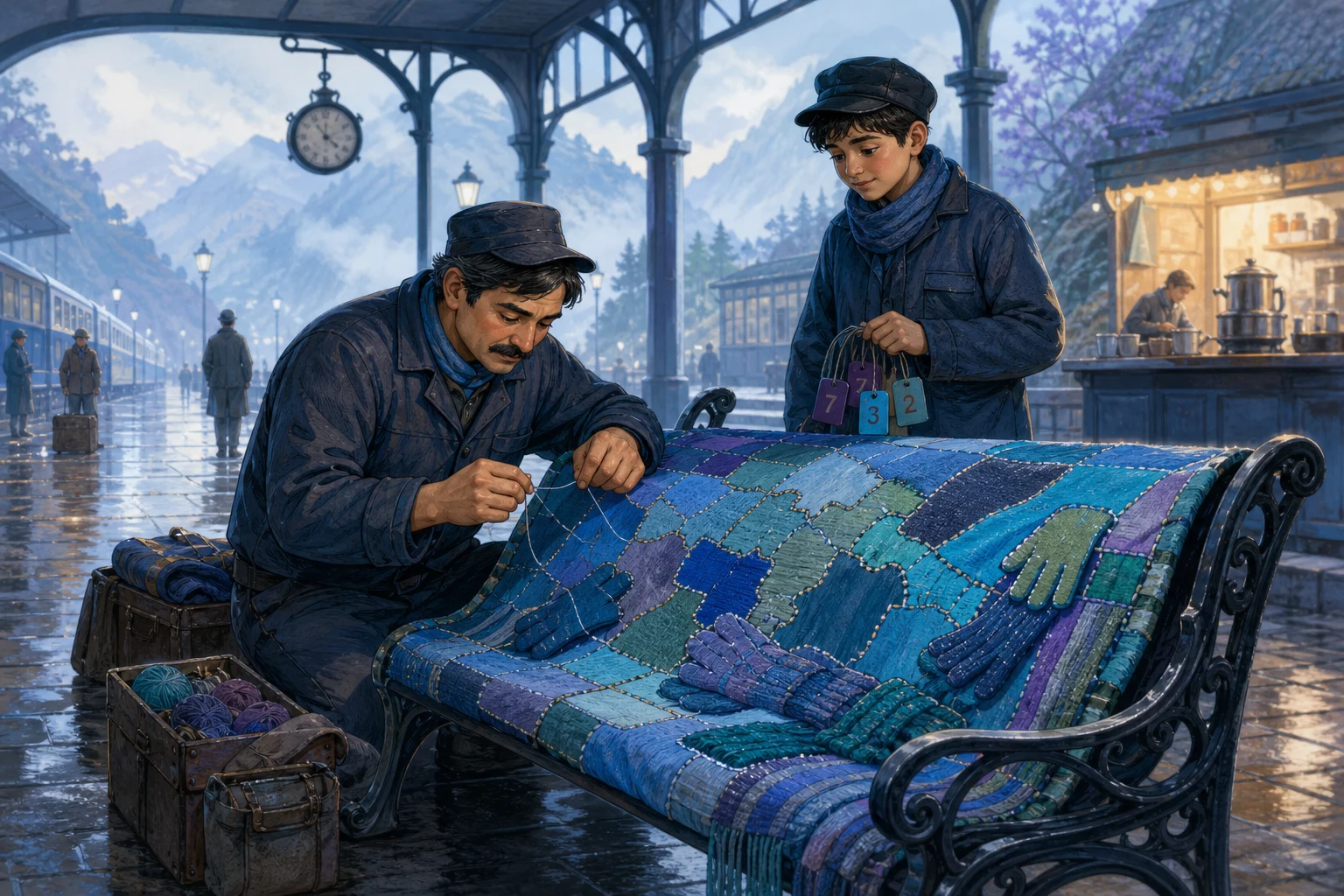
A Map Woven in Blue
Ilya’s patchwork bench covers began with lost gloves and ended as a map everyone could help complete.
Read Story →
The Hour Nobody Owned
Mina’s first community hour is lively, crowded, and almost entirely controlled by the loudest guests. A ferry cleaner, a brass token, and one patient adjustment teach her what true hospitality requires.
Read Story →
Tabs in the Wind
Kito’s first calendar was neat, accurate, and almost useless. The second one belonged to everyone.
Read Story →