
Quote Stories
Streets That Remember
Sami redraws a festival route by listening beyond the obvious landmarks.

By noon, Sami had sold twenty-three route cards and corrected six visitors who had folded theirs the wrong way.
“Keep the blue line uphill,” he told a couple balancing paper cups of lemon ice. “The red dots are steps. The yellow stars are shade.”
His cards showed the quickest path to the bell tower: past the tiled fountain, through the arch beside the fig tree, and up the grand stairway where the lantern procession would begin that evening. Sami had drawn every turn in colored pencil and added tiny bells at the corners. His grandmother, Nura, had taught him to notice such things.
She would lead the procession at sunset, carrying the long brass lantern at its front.
“Your map makes the climb look easy,” Nura said, examining one card beneath the awning of the bakery.
“It is easy if you follow the lines.”
Nura smiled, but her fingers lingered on the paper. “Lines do not always know the whole way.”
That afternoon, the procession gathered in the square. Lanterns swung from wooden poles. Musicians tuned their pipes. Children wore paper crowns that bent in the heat.
Nura lifted the brass lantern, and the crowd began uphill.
At the fountain, a vendor called out that the usual stairway was blocked by a fallen cart. Nura turned toward a narrow lane. The lane divided around a courtyard, and the courtyard opened onto three more lanes, each shadowed and unfamiliar beneath balconies hung with drying herbs.
The musicians stopped. People murmured. Someone asked Sami which way to go.
For once, he had no answer.
Nura looked at the three lanes, then lowered the lantern. “We’ll wait.”
The procession waited ten minutes, then twenty. A few visitors returned downhill. Nura’s shoulders tightened as though the brass lantern had grown heavier.
Sami unfolded his cards. The route was perfect until the fallen cart. Beyond that, his paper showed nothing.
The next morning, he carried a notebook through the streets. He asked the baker where the shade lasted longest. He asked a flower seller which steps became slippery after watering. He asked children where they stopped to trade marbles, and asked shopkeepers which doors were wide enough for a chair or a tired walker to pass comfortably.
Everyone had a piece of the route.
At the edge of town, Sami found a quiet neighborhood he had never marked: low houses painted the color of apricots, with a courtyard full of rosemary and a stone bench beneath a mulberry tree. An older man named Farid watched Sami sketch the lane.
“People come here only when they are lost,” Farid said.
“Then I should put it on the map.”
Farid looked toward the bell tower, hidden beyond the rooftops. “Put the bench on it too.”
Sami returned to the square with a new draft. It had three paths instead of one: the quickest climb, the shaded route, and the longer route through the mulberry courtyard. He added rest points, drinking fountains, broad passages, and landmarks that mattered only because someone had told him they did.
When he showed it to Nura, she studied the page silently.
“You left out the old lime kiln,” she said.
Sami blinked. “Is that on the way?”
“It is if you want to hear the swallows.”
He added it.
At sunset, Nura lifted the lantern again. This time the procession moved slowly, not because anyone was uncertain, but because people kept choosing different paths and meeting one another along the way. Children led some visitors toward the painted blue door. Shopkeepers offered water. At the mulberry courtyard, Farid rang a small handbell, and those on the main road heard it answer the great bell above.
Sami walked beside his grandmother, carrying a stack of revised cards.
“You could have made the first map bigger,” Nura said.
“I thought I knew the important places.”
“Now you know better.”
Near the tower, Sami saw one of his original cards tucked beneath a lantern. Its single red line ended at the blocked cart.
He did not throw it away. He drew a second line across it, then a third, until the old map held several ways forward.
Above them, the bell began to ring. The sound traveled over stairways, courtyards, balconies, and the quiet lane with the mulberry tree. No route carried everyone the same way, but every route led toward the music.
Related Quote Stories

When Desks Learned to Bend
Nera’s first folding desk collapsed under the weight of a single book. Hiding the failure would be easy; inviting others to inspect it would be harder—and far more useful.
Read Story →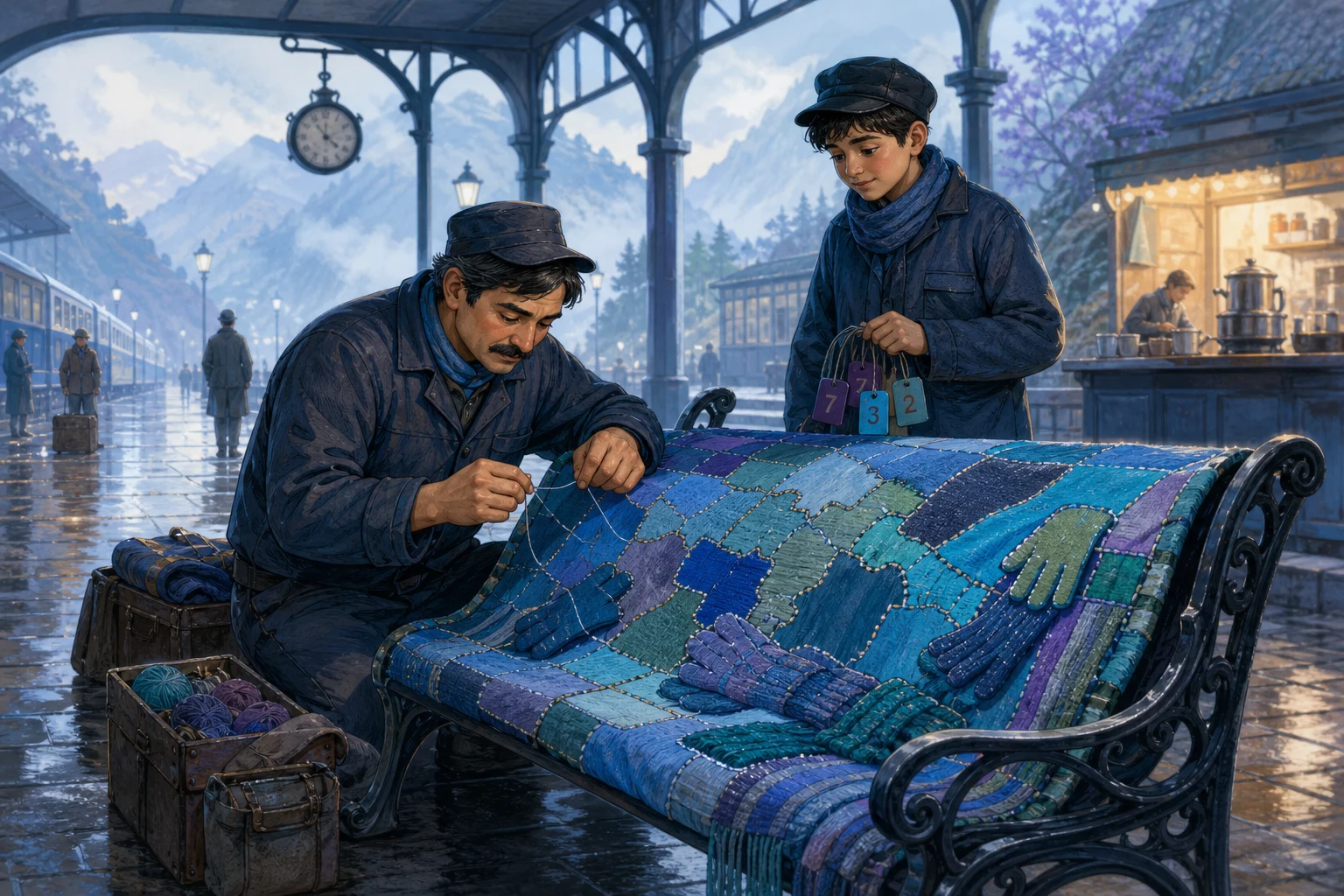
A Map Woven in Blue
Ilya’s patchwork bench covers began with lost gloves and ended as a map everyone could help complete.
Read Story →
The Hour Nobody Owned
Mina’s first community hour is lively, crowded, and almost entirely controlled by the loudest guests. A ferry cleaner, a brass token, and one patient adjustment teach her what true hospitality requires.
Read Story →