
Quote Stories
The Dictionary of Useful Words
A library aide discovers that understanding is something a community can build together.

The notice slid off the library counter and landed face down in a puddle of rainwater.
Nika rescued it with two fingers. The paper was crowded with official phrases, numbered sections, and one sentence that seemed to say the market stalls would be removed—but perhaps only the temporary ones, or perhaps only on certain days.
Across the room, a woman from the evening language class stared at her own form.
“Does this ask where I live,” she said, “or where I lived before?”
Nika read the line twice. She had been the library aide for three weeks and still worried that every answer she gave might turn out to be wrong.
“Let’s find out together,” she said.
That became the beginning of the dictionary.
Nika brought a stack of index cards to the library’s long oak table. On each card, she wrote one troublesome word: proof, appointment, temporary, household, eligible. Visitors added translations, drawings, examples, and warnings.
“Temporary does not always mean short,” said Lio, a baker who had moved near the lake the previous winter. “Sometimes it means nobody promises how long.”
“Eligible means you may apply,” wrote a retired teacher. “It does not mean you have already received anything.”
A child contributed a drawing of an arrow beside the word exit. Someone else added three ways to ask, “Could you explain that?” without sounding angry.
The cards multiplied. They filled a wooden file box, then two. Nika called the project the Dictionary of Useful Words, though useful words were not always single words. Sometimes they were whole sentences, such as: I understand the first part, but not the last part.
Every Thursday, a teenage volunteer named Sava helped sort the cards. Sava had a talent for noticing when a sentence hid more than it said. He also had a talent for making jokes at precisely the wrong moment.
One afternoon, he held up a card marked clarification.
“This is a fancy word for asking someone to stop being mysterious,” he said.
“It is a fancy word for asking carefully,” Nika replied.
“Those are not always the same thing.”
“No,” she said. “That is why we practice.”
The Notice
The notice that had fallen into the puddle belonged to Deren, the carpenter whose workshop stood beside the market. He arrived at the library carrying the damp paper in a leather folder.
“I can read it,” he announced before anyone offered help.
Nika closed the dictionary box. “Of course.”
“It says the workshop must relocate.”
Sava leaned forward. “Does it say where?”
Deren’s gray eyebrows lowered. “It says enough.”
He explained that the market board planned to repair the lakeside walkway. The notice required several businesses to submit relocation preferences by Monday. Deren had ignored the bottom half because the language made his eyes ache, and now he believed the board had already chosen a place for him.
“I built that workshop,” he said. “I am not asking strangers where I may put my own tools.”
Sava glanced at Nika. She knew that look. He wanted to ask a question. He also knew Deren might hear it as an accusation.
Nika took a card from the box.
“Would you like us to read the notice with you,” she asked, “or would you like us to help you write to the market board?”
Deren looked at the two choices. His hand tightened around the folder.
“I would like to know what it says.”
They spread the notice across the table. Sava read the first paragraph aloud. Nika marked the dates. Deren tapped the phrase submit preferences.
“That means they have not chosen,” Nika said. “They are asking each workshop to name a preferred location.”
Deren sat back. “Then why make it sound as if we are already being pushed away?”
“Because the sentence is badly built,” Sava said.
Deren gave him a sharp look.
Sava swallowed. “I mean, it could be clearer.”
They read on. The board would provide three possible sites and pay for basic moving costs. Deren still disliked the plan. The workshop’s current windows faced the lake, and his customers knew where to find him. But the decision had changed shape. It was no longer a command with no reply. It was a question with a deadline.
“What happens if I do not answer by Monday?” Deren asked.
Nika found the relevant line. “Your preference may not be considered.”
Deren stared at the page.
“Write that one down,” he said.
Sava reached for a blank card.
The Exact Question
On Friday, Deren returned with a list of questions. Not complaints. Questions.
Would the new site have enough light for finishing work? Who would pay to reconnect the machines? Could customers still reach the shop without crossing the construction area? What did basic moving costs include?
The dictionary gained a new section: Questions Worth Asking.
At the market board’s meeting, Deren stood beside Nika and Sava. He did not let them speak for him. When a board member used the phrase provisional access arrangement, Deren raised his hand.
“Please say that plainly.”
The board member paused. “You could use the new walkway before all repairs are finished, but access might change from week to week.”
Deren nodded. “That is useful.”
Other shopkeepers began asking questions too. A fruit seller wanted to know whether delivery carts could pass. Lio asked whether temporary storage meant one week or one season. Sava wrote each answer on a pad, leaving space beneath for corrections.
By the end of the meeting, no one was delighted by the relocation. But everyone knew what had been decided, what remained open, and which questions required written answers.
The workshop moved two months later to a bright brick room near the covered market. Deren disliked the first proposed site and chose the third. It had less lake view but better light. The moving crew arrived late, and one cupboard lost a door. Still, his tools were installed before the first customer came looking for a repaired chair.
Deren gave Nika a small wooden box on opening day. Its lid held a brass plate engraved with one word: clarify.
Inside were freshly cut cards.
“What are these for?” Sava asked.
Deren placed a card on the counter. “Words I do not understand.”
Sava smiled. “You could ask us.”
“I could,” Deren said. “But I might ask the wrong question.”
Nika handed him a pencil. “Then we will make the question better.”
By winter, the Dictionary of Useful Words had traveled beyond the library. Copies sat in the market office, the adult-learning room, and Deren’s workshop. The cards were never identical. Each place added its own examples, translations, and corrections.
On the first page of the newest copy, Nika wrote:
A useful word is not one that makes you sound clever. It is one that helps another person know what to do next.
Deren read the sentence, then added a card beneath it.
ask again.
He underlined it twice.
Related Quote Stories

When the Courtyard Kept Time
Sela repaired the courtyard clock to serve the night workers who passed beneath it. Then its cheerful chimes woke the people sleeping nearby. To make time welcoming to everyone, she had to stop measuring it alone.
Read Story →
When Desks Learned to Bend
Nera’s first folding desk collapsed under the weight of a single book. Hiding the failure would be easy; inviting others to inspect it would be harder—and far more useful.
Read Story →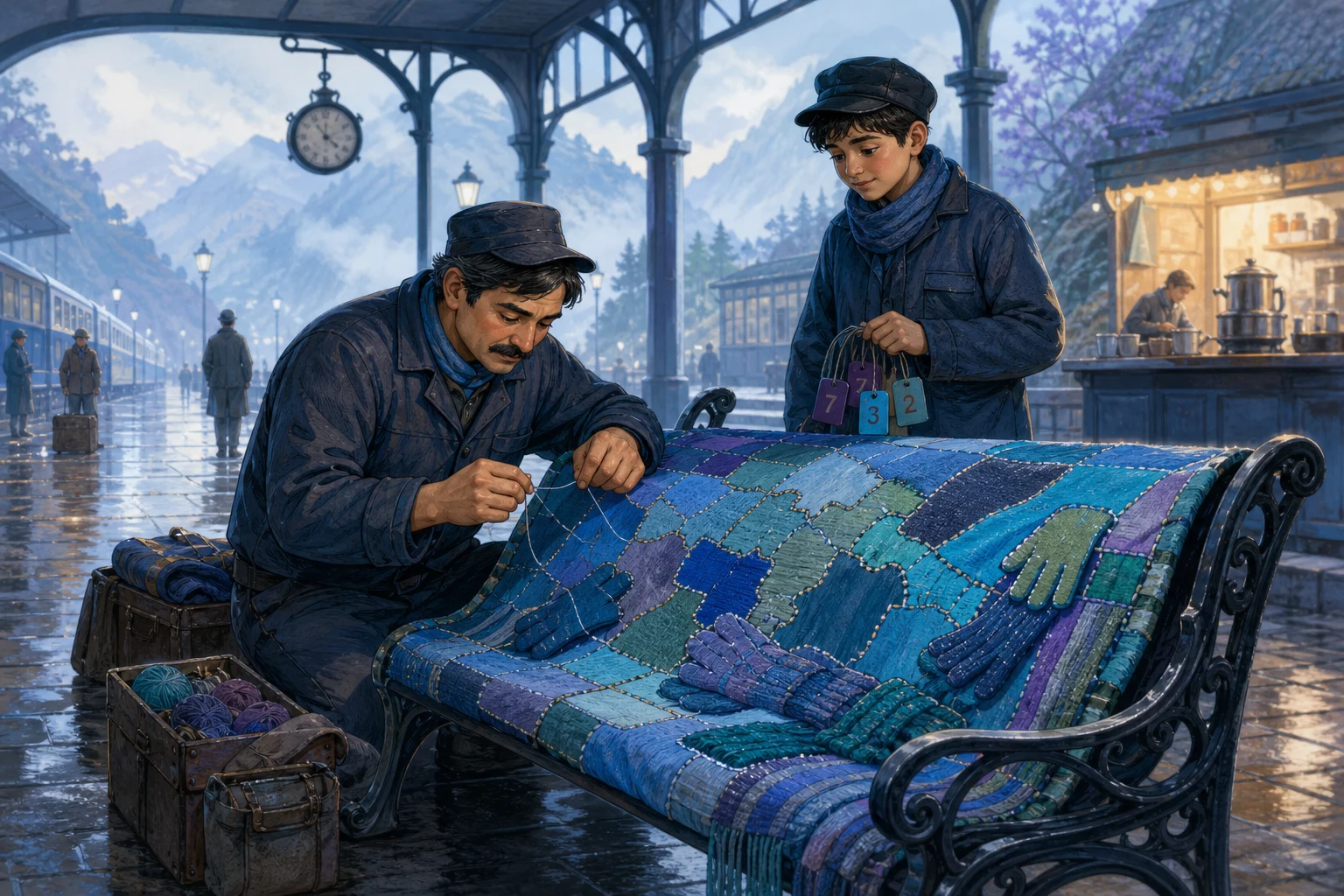
A Map Woven in Blue
Ilya’s patchwork bench covers began with lost gloves and ended as a map everyone could help complete.
Read Story →