
Quote Stories
Where the Current Slows
A ferry clerk discovers that welcome works best in both directions.
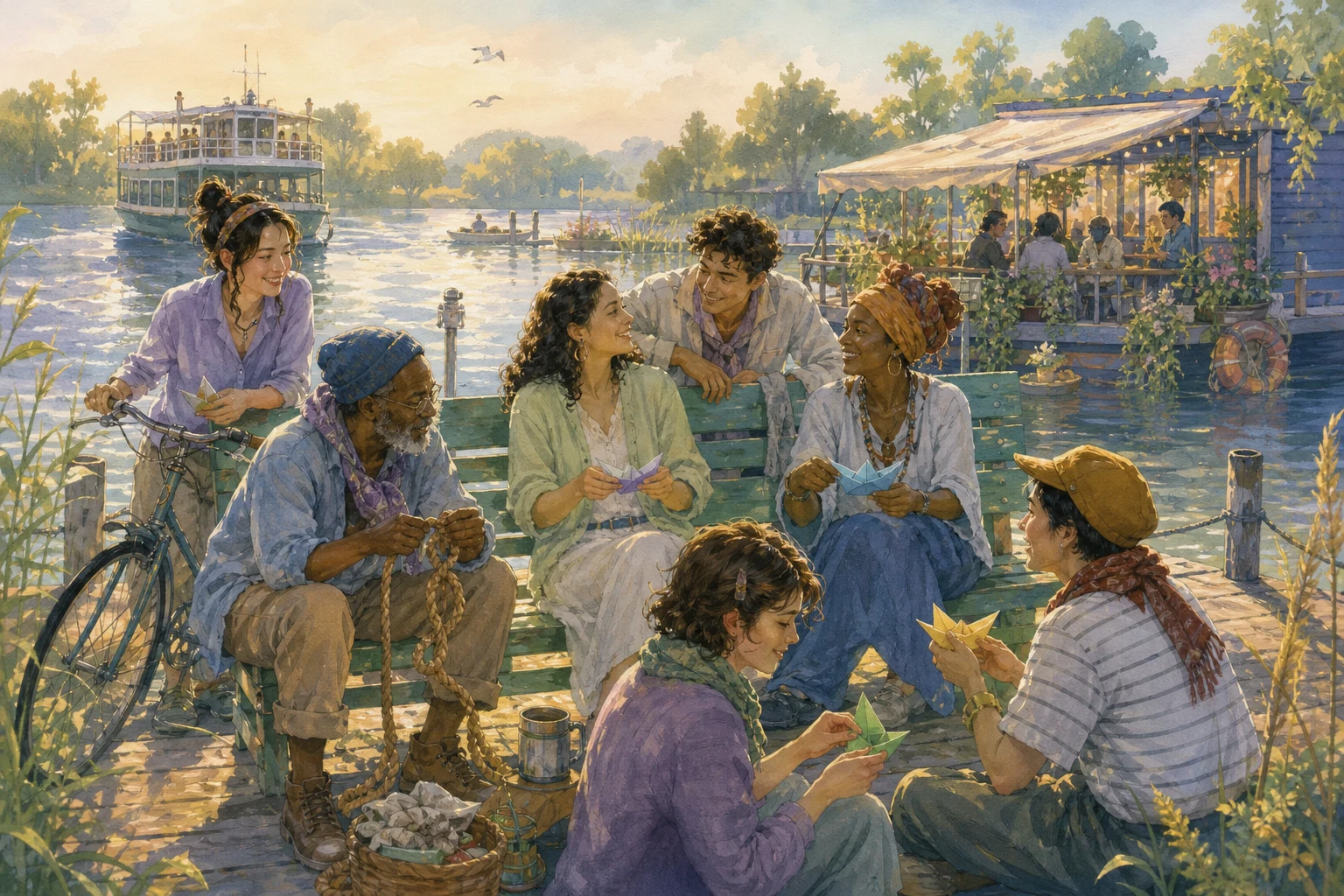
Amara noticed the empty bench before she noticed the silence.
It stood beside the ferry shelter, painted green long ago and polished smooth by weather and waiting. Each afternoon, people heading to the language school gathered along the dock. New arrivals sat at one end. Longtime residents occupied the other. Between them, the bench remained untouched, as if an invisible passenger had reserved it.
Amara sold ferry tickets from a booth with windows on three sides. She knew who carried fishing baskets, who preferred the upper deck, and who always arrived with exactly one minute to spare. She also knew that many passengers had words they wanted to use but no comfortable place to try them.
So she made cards.
On each card she drew an ordinary object: a key, a lunch tin, a scarf, a spoon. Every Thursday, after her shift, she placed the cards on the green bench and invited people to choose one and ask a question about it.
“What does this open?” she asked the first evening, holding up a key.
“A door,” said Pavel.
“A lock,” said Nura.
“A drawer where my brother hides sweets,” said Heshan.
That answer earned a laugh. Amara went home pleased.
The next week, fewer people came. The week after that, only three. They answered carefully, looking at Amara for approval after every sentence. The gathering had become another class, and Amara—who had never intended to be a teacher—had somehow become the strictest pupil in the room.
On the fourth Thursday, a gust swept the cards into the river.
Amara lunged after them, caught one against a mooring post, and came back dripping to the knees.
Nura stared at her. “You ask questions,” she said. “But you do not answer.”
Amara looked at the soggy card in her hand. It showed a scarf.
“What would you ask me?”
Nura considered. “Why do you wear the same blue scarf every day?”
“Because my sister knitted it badly,” Amara said. “The ends are different lengths.”
Nura inspected the scarf. “Very badly.”
This time, everyone laughed—including Amara.
The following week, she brought no cards. Instead, she placed a notice on the bench: Bring something you know how to do. Bring something you want to learn.
Pavel brought rope and demonstrated a sailor’s knot that held tight but came loose with one tug. Nura folded paper boats and taught everyone how to make a pointed bow. Heshan arrived with a bicycle missing one pedal and showed three people how to balance before pushing off. Amara tried, wobbled six feet, and fell into a heap of ferry timetables.
“You have chosen a difficult boat,” Pavel told her.
“I’m beginning to suspect the bicycle is judging me,” she replied.
The dock changed by small degrees. Someone brought a tin of spiced biscuits and labeled each one in three languages. Someone else taught a local clapping song whose rhythm was easy and whose verses were not. A retired boat mechanic repaired a loose wheel on the language school’s book cart. In return, a student showed him how to use the translation function on his phone, though he insisted the device was “a very small, impatient clerk.”
Attendance still rose and fell. Rain emptied the bench. A delayed ferry filled it. Some evenings were noisy; others held only two people and the river’s slow slap against the pilings.
Then, one Tuesday, the ferry’s morning bell jammed. Passengers crowded the dock while Amara searched for the missing brass pin. She found it beneath the green bench, where the river breeze had blown it into a crack.
By the time the bell rang, the bench was full. Pavel was tying a temporary loop around the mechanism. Nura was explaining the repair to a new passenger. Heshan was balancing on the old bicycle, now repaired, while two children cheered.
There was no empty space left between anyone.
Amara sat at the edge, her blue scarf crooked around her neck. Nura handed her a folded paper boat.
“Your turn,” she said. “Teach us something.”
Amara thought of ferry routes, tide marks, and the subtle difference between a boat arriving and a boat merely passing by.
Then she pointed across the water. “I know how to tell when the current is slowing.”
Everyone leaned closer.
And this time, Amara began by listening to what they already knew.
Related Quote Stories

Names Beneath the Leaves
Sela thought every plant needed a fact card. Then the residents taught her that gardens remember people, too.
Read Story →
Before the Oven Wakes
Salma knew how to make dough behave. Teaching Ren was another matter entirely.
Read Story →
Light Between Floors
When the laundry room lights keep failing, an apartment electrician stops replacing bulbs alone and starts building confidence instead.
Read Story →