
Quote Stories
How Celia Found the Entrance
A choir learns that harmony can begin in more than one way.

“You’re early,” said the conductor.
Celia looked up from the folding chair she was unfolding. “I was an usher for thirty-one years. Early is the one part I can still perform without rehearsal.”
The choir laughed, and Celia smiled. She had moved to the river island only two months before, into a quieter apartment above a shop that sold umbrellas and repaired clocks. The choir rehearsed in a public hall above a bookshop, where ferry horns trembled through the windows and the floor tilted slightly toward the river.
At first, Celia liked everything about it: the tea in chipped blue cups, the alto beside her who always carried peppermints, the conductor’s bright red scarf. Then the scores arrived.
The black notes crowded the page like tiny birds startled into flight. Celia could follow the first measure, sometimes the second. By the third, she was quietly guessing. When the choir practiced a complicated passage for the river festival, her guesses began arriving in the wrong places.
“I’m not sure this is for me,” she told the conductor after rehearsal.
The conductor, Mara, glanced at the score. “The music is difficult.”
“That is a polite way of saying I am lost.”
“Are you lost,” Mara asked, “or are you listening for a different map?”
Celia thought of the old cinema where she had worked. She remembered helping children find their parents after intermission, guiding latecomers down dark aisles, and knowing from the rustle of a program when an audience was about to laugh. She also remembered that many patrons had never learned to read the small signs above the doors. They found their seats by watching, listening, and following a hand.
The next rehearsal, Celia arrived with three saucepan lids, a packet of colored cards, and no score.
“I have an idea,” she announced.
It was not immediately a good idea. The saucepan lids were too loud. One colored card fell into the heating vent. The first attempt at spoken rhythm collapsed when everyone emphasized a different syllable. But beneath the confusion, Celia noticed something: she was not the only singer watching others before entering. Two altos were marking their pages with dots. A tenor hummed softly before each phrase. Mara herself tapped the beat against her wrist.
So they tried again.
Celia arranged the singers in a circle. They spoke the poem’s rhythm before singing it. Mara used simple hand signals for beginning, holding, and stopping. The experienced readers kept their scores open, while everyone else learned the melody through repetition. When a singer missed an entrance, nobody stopped the music; the nearest voice offered the phrase again.
The choir still sounded uneven. It also sounded warmer.
At the festival, rain pushed the performance beneath a ferry shelter. People gathered between wet umbrellas and crates of flowers. The choir began the first song with a brief spoken rhythm, soft as footsteps. Then the melody rose—sometimes clear, sometimes wavering, once interrupted by a passing barge.
Celia missed her entrance. For half a breath, embarrassment tightened her throat. Then the alto beside her touched two fingers to her palm: wait, now.
Celia entered.
By the final song, people under the shelter were singing along. A boy near the ticket booth copied Mara’s hand signals. The conductor watched him, then widened the circle so he could see better.
Afterward, Celia gathered the colored cards and tucked them into her handbag. Mara asked whether she would return next week.
“I suppose someone has to show the new people where to come in,” Celia said.
She paused at the hall’s stairway. Below, the bookshop was closing. Across the river, lamps came on one by one, reflected in the dark water like notes waiting for their turn.
Celia went back upstairs and put her chair in the circle—not at the edge, and not quite in the center, but exactly where the next voice could find her.
Related Quote Stories
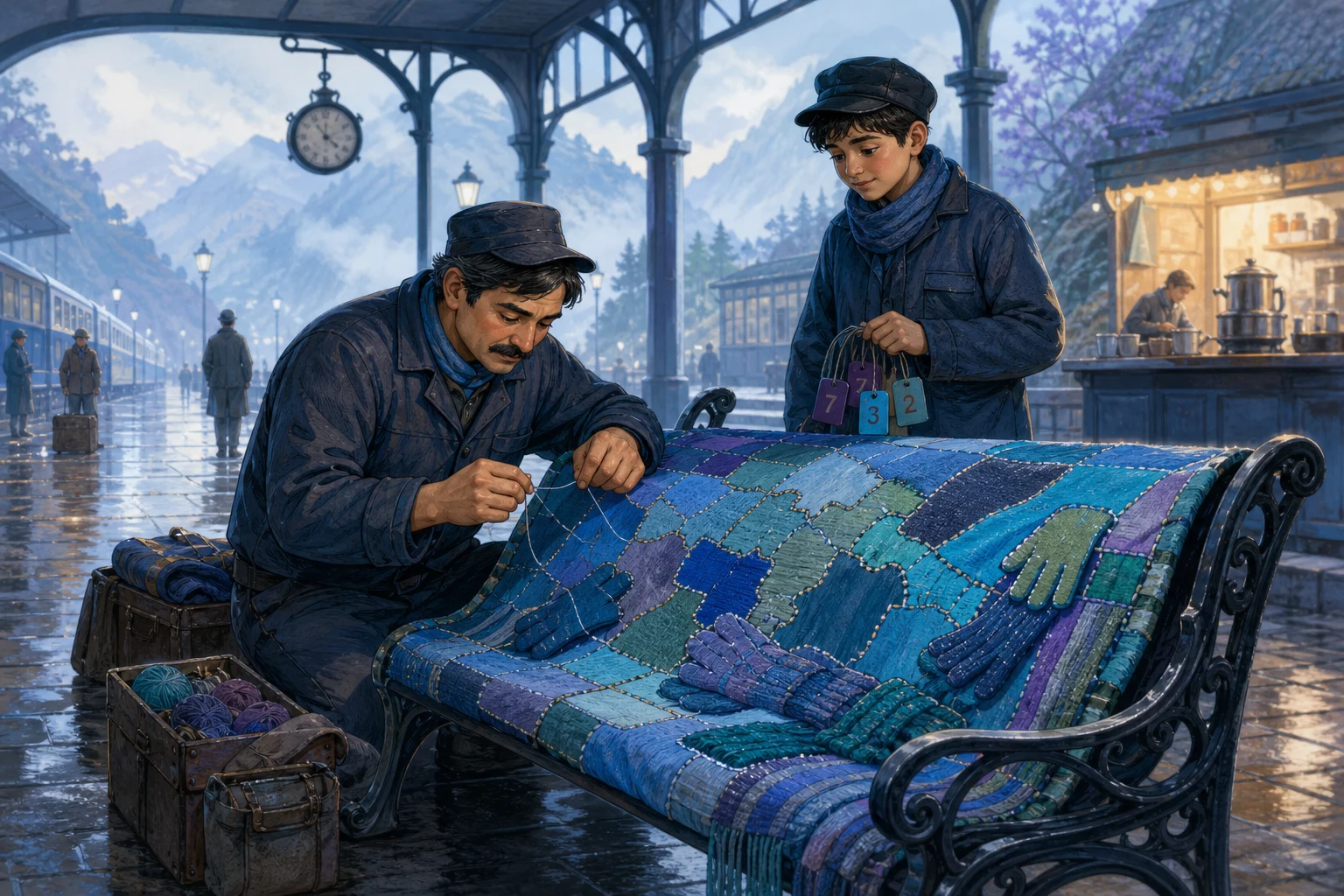
A Map Woven in Blue
Ilya’s patchwork bench covers began with lost gloves and ended as a map everyone could help complete.
Read Story →
Where the Shade Falls
Tomas had already measured the orchard for sale when three young workers asked whether they could borrow it for one afternoon.
Read Story →
A Tune for Every Pocket
Celia could repair almost anything with a spring, a screwdriver, and enough patience. Her niece’s silence in music class required something different.
Read Story →