
Quote Stories
Names for Every Turn
Lina learns that the surest route begins with listening.
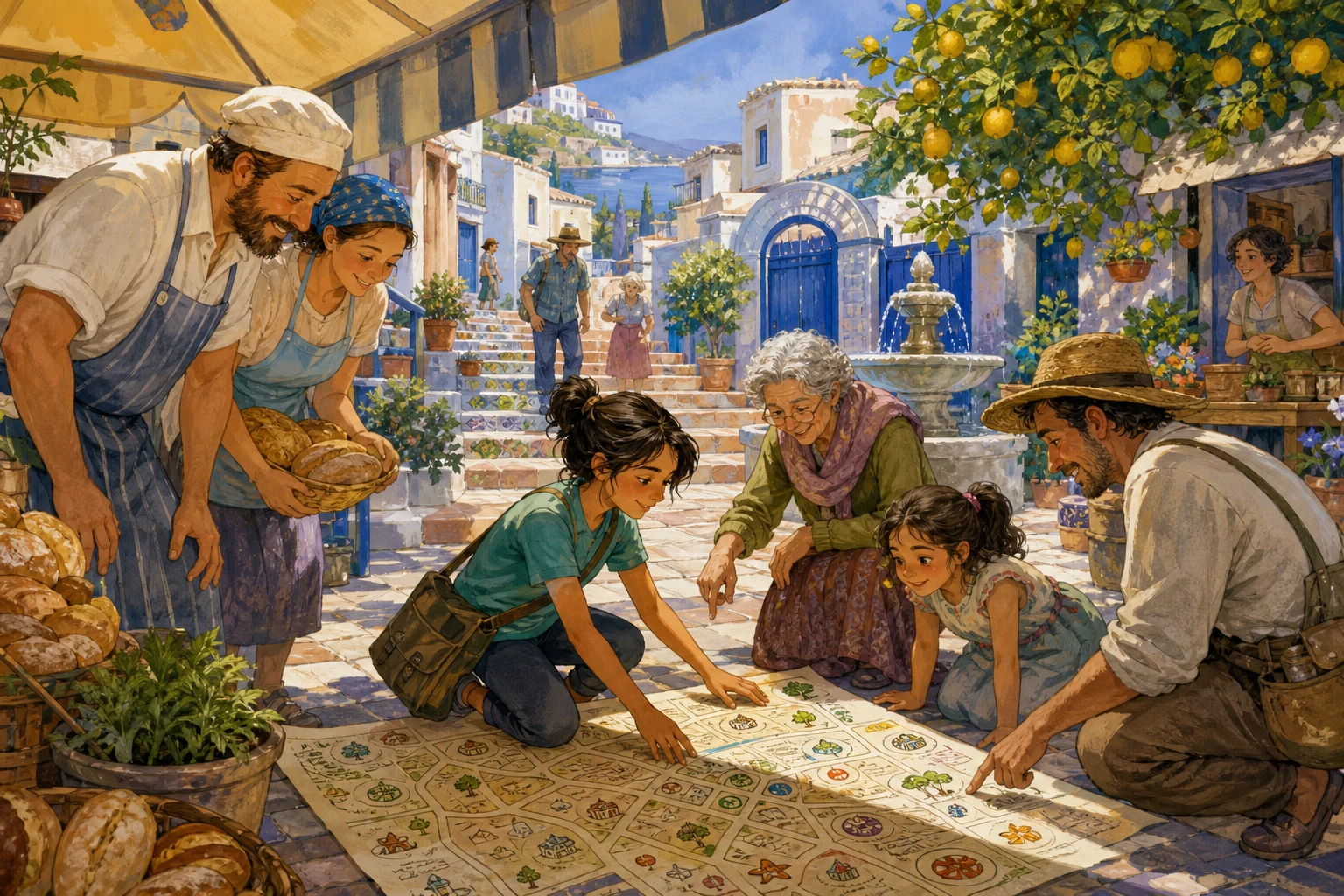
The parcel marked “Mina’s house, above the blue gate” slid from Lina’s basket and landed in a basket of lemons.
She stared at it. The lemon seller stared back.
“Unless Mina has recently opened a fruit stall,” he said, “you want the steps behind the bakery.”
Lina snatched up the parcel. “I know where I’m going.”
She had drawn her own map that morning, before the bells began calling people to the market. It showed every lane in straight lines, every house in tidy squares, and a bold red arrow pointing uphill. It did not show the bakery, the blue gate, or the lemon seller’s stall.
By noon, Lina had delivered two parcels correctly, left one at the wrong workshop, and carried another all the way to the public fountain before discovering that “the house with the sleeping cat” had three possible roofs.
At the courier desk, she spread out her map and pressed both palms against it.
“It is accurate,” she told her older brother.
“Then perhaps the town is inaccurate,” he said.
Lina did not laugh. She wanted to prove she could manage the afternoon route alone. Instead, she returned to the hill with a stub of charcoal and a question.
At the bakery, she asked the baker to point out Mina’s steps. He drew a floury thumbprint beside a narrow passage and added, “Turn where the oven smells sweetest.”
The watchmaker marked a shortcut through the courtyard. Two children sketched a lopsided fountain that leaked only in summer. An old gardener explained that the stone wall called “the long wall” ended beside a fig tree, though the fig tree had been cut down years ago.
“People still use it to name the place,” he said.
Lina began recording everything: blue gates, cracked bells, painted fish, wells, workshops, shade at noon. She made symbols for the community kitchen and the classroom above the olive press. When she was unsure, she left a blank space instead of guessing.
The map grew messy. It also grew useful.
On market day, Lina carried a fresh copy to the courier desk. A newcomer stood there holding a letter and looking helplessly at an address that named three relatives but no street.
Lina opened the map. “Do you know whether the house is near running water, orange trees, or the bell that rings late?”
The newcomer thought. “Orange trees.”
“Then we begin here.”
Soon the map traveled beyond the courier desk. A teacher used it to guide new pupils to class. A cook marked the community kitchen. A visiting family followed its symbols to the public well. Even Lina’s brother used it when he needed the quickest way to the repair shop.
Weeks later, Lina redrew the map on a broad sheet and pinned it beneath the market awning. There were still crooked lines and disputed landmarks. Someone had added a tiny cat beside a roof. Someone else had written, “Ask at the blue door.”
Lina smiled and left room at the bottom for more additions.
A place could be measured with numbers, she had learned. But finding your way through it required knowing what mattered to the people who lived there.
Related Quote Stories
When the Building Learned to Listen
Lidia thought quiet could be enforced until a building full of strangers showed her that peace begins with knowing what everyone else is carrying.
Read Story →
Soles for the Evening Tide
When cheap shoes begin replacing careful repairs, Niko opens his stall to neighbors—and discovers that teaching his craft may be the repair his own livelihood needs.
Read Story →
The Stop Between Clocks
When evening apprentices keep missing class, a bus driver tries to fix the route alone—and discovers that the best detour is a shared plan.
Read Story →