
Quote Stories
The Cartographer of Small Repairs
A fictional story about bicycles, music, and the shapes that memories keep

In the fictional river city of Bellwether, the river ran beside the market like a long blue ribbon, carrying willow leaves, paper boats, and the occasional orange peel.
Marek’s bicycle shop stood beneath the market’s oldest awning. He was a meticulous mechanic who could true a wheel by sound alone, but he preferred tools to conversation. His answers were usually the length of a wrench.
Every week, children left broken toys near his back door: a wooden beetle with one leg, a wind-up bird that chirped only backward, a cardboard boat softened by rain. Marek repaired bicycles for grown customers, but the toys remained in a crate marked UNFINISHED.
One Saturday, he carried the crate into the sunlight and set up a folding table.
“Bring the owners,” he told the children. “Not just the objects.”
At the table, the children asked questions before touching anything. Where did it break? What was it meant to do? Which part mattered most? They sketched possible repairs on scraps of bicycle invoices. Marek showed them how to hold a spring without pinching a finger and how to admit, “I don’t know yet.”
The quietest child was Nella. She drew beautiful diagrams but hid them beneath her elbow whenever anyone looked. Her ideas, she believed, were too small to be useful.
Then she brought a music box.
It had belonged to her aunt, who had died the previous winter. The box was painted green, though much of the paint had worn away. Its brass dancer leaned to one side, and when Nella turned the key, it played a wavering tune: three clear notes, a pause, then a trembling fourth.
“My aunt used to wind it when the river fog came in,” Nella said. “It hasn’t sounded right since.”
Marek opened the case. Inside, a tiny metal tooth had bent away from the cylinder. He could replace it, polish the gears, and make the tune precise again.
The children gathered around Nella’s sketch. Some wanted a perfect restoration. Others liked the pause and the trembling note.
“It sounds like it is trying to remember,” said Tavi, who usually brought the most impossible toys.
Nella touched the worn paint. “If we fix it completely, will it still be hers?”
No one answered at first.
Marek removed his magnifying lens. “What does the owner want?” he asked.
Nella looked at the music box for a long time. Then she drew two plans. In the first, they would replace the bent tooth and smooth the tune. In the second, they would straighten it only enough to keep the box turning, leaving the pause and the trembling note intact.
She chose the second plan.
The work took all afternoon. Nella held the lamp. Tavi made a paper brace for the dancer. Marek adjusted the tooth by fractions, stopping whenever Nella raised a finger. At last, the cylinder turned without catching.
The music box played its familiar little journey: three clear notes, a pause, and the trembling fourth.
Nella smiled—not because it sounded new, but because it sounded near.
Before closing, Marek added a fresh sign above the table. It read:
SMALL REPAIRS — ASK FIRST.
The next Saturday, Nella arrived early with a stack of blank paper. She had drawn a map of the workshop, marking the places where people had helped one another: the lamp, the tool tray, the tea kettle, and the chair where owners waited while their treasures were being understood.
Marek studied the map. Then he handed her a red pencil.
“Add the river,” he said.
Nella did. It ran around the whole page, carrying every repair onward.
Related Quote Stories
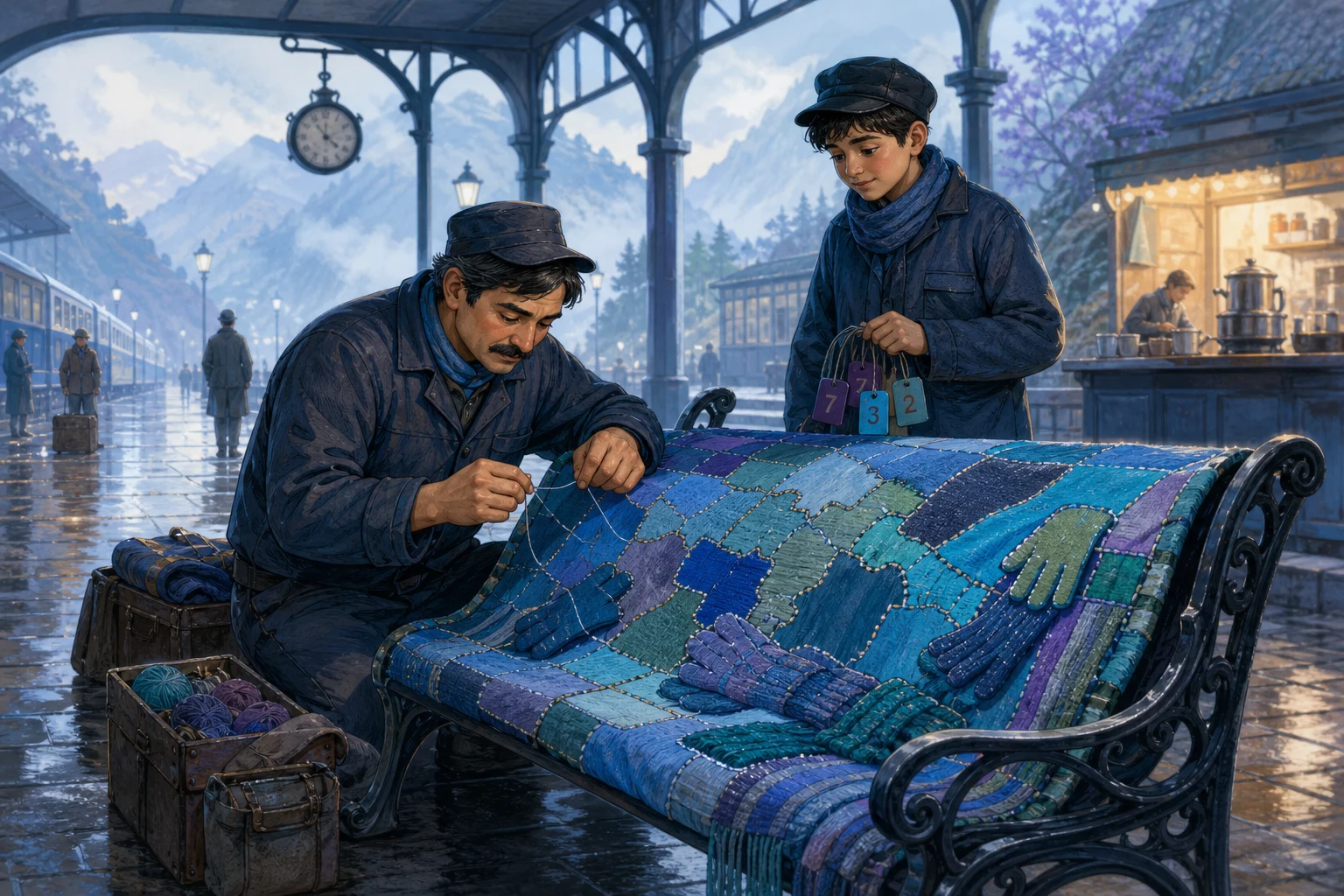
A Map Woven in Blue
Ilya’s patchwork bench covers began with lost gloves and ended as a map everyone could help complete.
Read Story →
Where the Shade Falls
Tomas had already measured the orchard for sale when three young workers asked whether they could borrow it for one afternoon.
Read Story →
A Tune for Every Pocket
Celia could repair almost anything with a spring, a screwdriver, and enough patience. Her niece’s silence in music class required something different.
Read Story →