
Quote Stories
The Hour They Made Together
A clockmaker learns that keeping time can also mean making room for change.
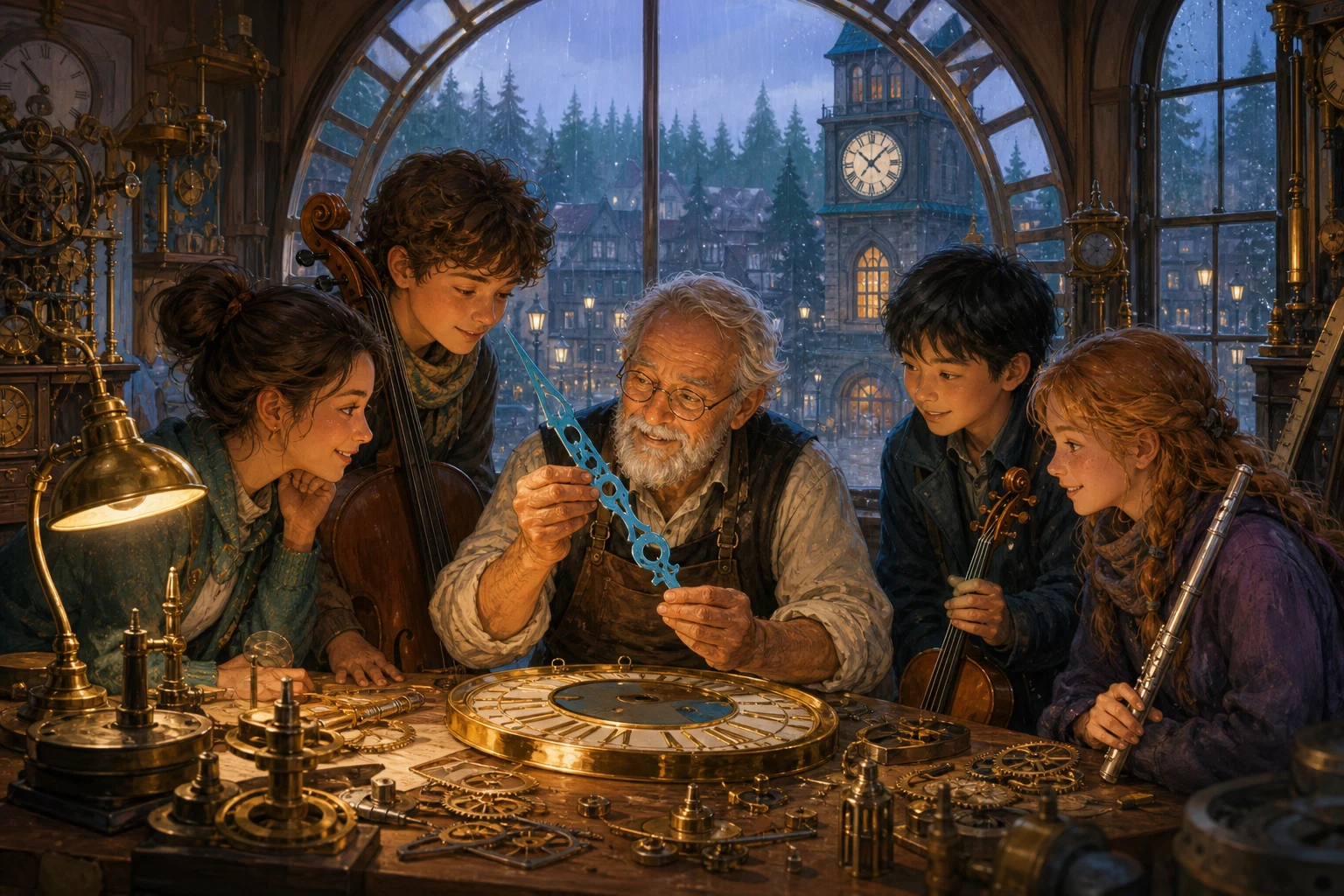
“If the clock cannot keep time, perhaps it can keep rhythm.”
Ansel looked over the rim of his spectacles at the four musicians standing in his workshop. Rain ticked against the windows. Behind them, beyond the pine-lined square, the town clock showed the same hour it had shown for eleven months: ten minutes past two.
“The hour hand is missing,” Ansel said. “It is not a percussion instrument.”
“We noticed,” said Lio, the cellist. “That is why we brought you this.”
She placed a crooked brass hand on his workbench. It had been cut from an old market sign, and someone had painted a tiny blue note near its tip.
Ansel pushed it back. “Too heavy. Poorly balanced. The hole is the wrong size.”
“We thought you might teach us how to fix those things.”
He almost told them to ask someone younger. His workshop had been closed since the clock’s last failure, though he still oiled the tools each morning and dusted the empty chair by the stove. At seventy-nine, Ansel knew exactly how a mechanism could fail. What he no longer trusted was his ability to make it work again.
Instead, he took out a ruler.
For three afternoons, the musicians learned about gears, counterweights, brass fatigue, and the stubborn habits of old wood. They learned that a clock did not merely move forward; every wheel depended on another wheel moving honestly with it. Ansel learned that Lio tapped her bow against her boot when thinking, that Pera the drummer could hear a loose screw from across the room, and that quiet Senn drew excellent diagrams when he stopped apologizing for them.
Their first replacement hand reached the tower on a bright market morning. It was elegant, blue-painted, and twelve grams too light.
At noon, the clock raced ahead. By half past, bakers were pulling loaves from ovens early, the covered market was closing before customers had finished shopping, and the school bell rang while the children were still lining up.
Pera arrived at the workshop breathless. “The clock says the music lesson ended before it began.”
Ansel sat beneath the stopped wall clock, pressing his thumb against a brass gear. “I warned you.”
“No,” said Lio. “You warned us about the hand. We should have asked what the clock is for.”
The question stayed in the room.
The musicians spent the next day walking through the square with notebooks. They asked the baker when the ovens needed tending, the ferryman when the morning fog lifted, the market sellers when shade reached their stalls, and the school caretaker which bell people could hear from the far lane. Ansel came along, carrying his cane and correcting their measurements until he noticed that nobody was asking him what mattered.
At the fountain, a woman who sold knitted mittens said, “The clock used to tell me when my sister would come by. She cannot climb the tower steps anymore, but she can hear its chime.”
At the edge of the forest road, a woodcutter asked whether the bell could wait until the workers were safely off the trail.
Ansel wrote both answers down.
Back in the workshop, they removed the blue hand. Senn suggested a sliding counterweight. Pera proposed two chimes instead of one: a bright note for gatherings and a low note for closing time. Lio wondered whether the clock could have a small adjustment lever, allowing the town to shift its evening signal during long summer light.
Ansel frowned at the sketches. Then he reached beneath the bench and brought out a wooden case.
Inside lay a collection of parts he had made over decades but never used: springs shaped for different tensions, silent hammers, spare gears, and a set of delicate counterweights.
“I kept them because they might be useful someday,” he said.
“Today seems like someday,” Senn replied.
The second hand took a week. The musicians sanded it, balanced it, painted it, and tested it against three borrowed clocks. Ansel showed them where to leave a little freedom in the joints. “A mechanism that cannot flex will eventually break,” he said.
On the first clear evening of autumn, they climbed the tower together. Below, the square glowed with shop windows and lanterns. The forest rose dark and fragrant beyond the last roofs.
Ansel fitted the hand into place. Lio adjusted the counterweight. Pera held the chime cord. Senn watched the gears.
“Ready?” Lio asked.
Ansel looked at the clock face. For nearly a year, he had seen only the absence where the hour hand should be. Now he saw the careful marks of four young hands, each different, each necessary.
“Let it go,” he said.
The mechanism began to turn.
At the hour, the clock gave a clear note. Then, after a breath, a lower one answered. Across the square, the baker lifted his head. The mitten seller opened her door. From the music school came four instruments finding the same pulse—not perfectly, but together.
The clock did not return to its old schedule. It gained an adjustment lever, a gentler evening chime, and a small brass plaque listing the people who had helped decide what its hours should mean.
Ansel reopened his workshop the following week. He still repaired clocks, but he left the front door unlatched on lesson afternoons. A wooden sign appeared in the window:
CLOCKS MENDED. QUESTIONS WELCOME.
Sometimes the musicians arrived with a broken spring. Sometimes they brought no tools at all, only a tune they wanted the tower to hear.
And whenever the new hour hand moved across the face, Ansel watched it with satisfaction—not because it was flawless, but because it had room to move.
Related Quote Stories

Where the Shade Falls
Tomas had already measured the orchard for sale when three young workers asked whether they could borrow it for one afternoon.
Read Story →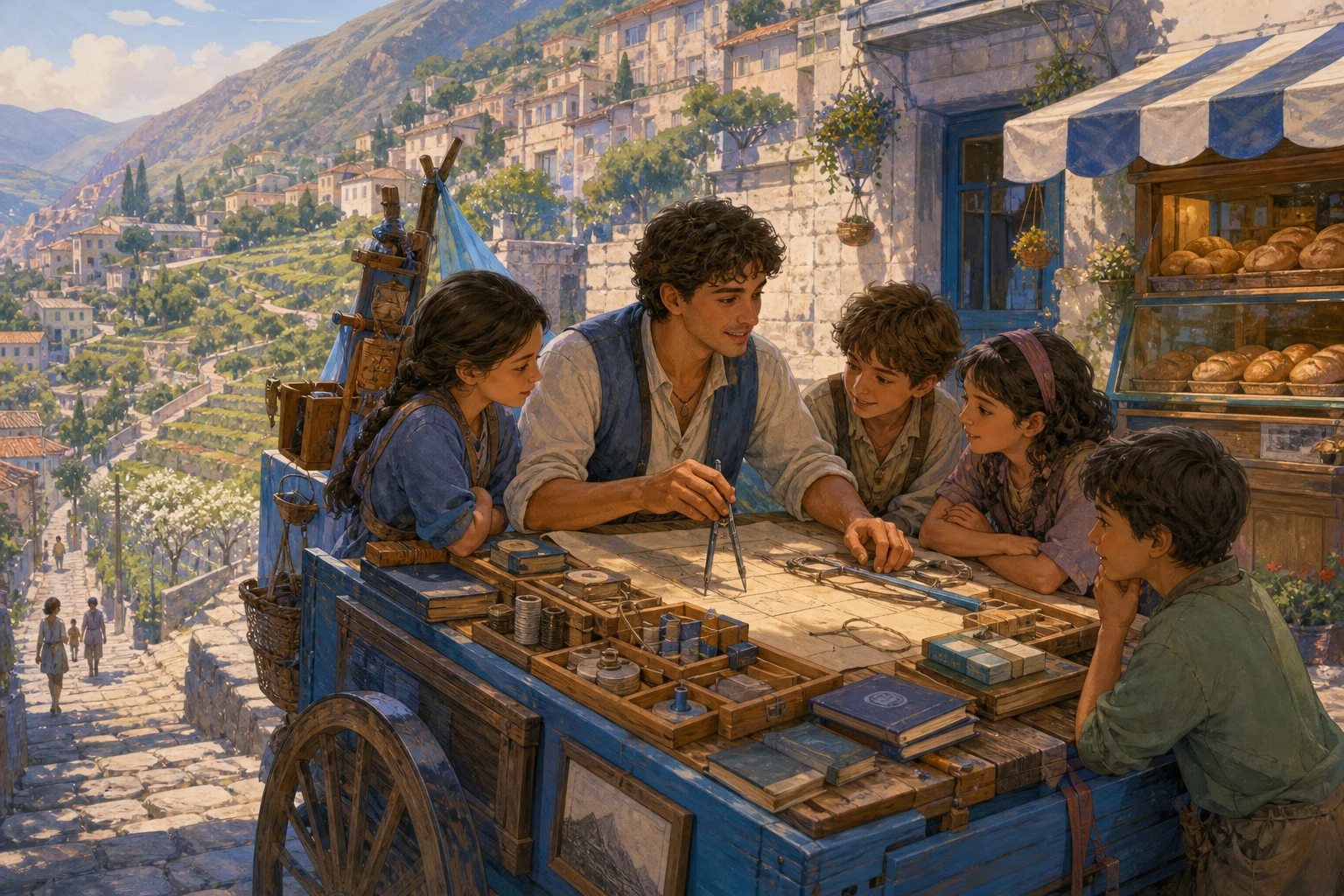
Lessons on Four Wheels
After losing his mapmaking contract, Elian rebuilds a handcart and fills it with puzzles, measuring tools, and books. The first lessons fail—until the people he hopes to teach show him how learning can begin with ordinary things.
Read Story →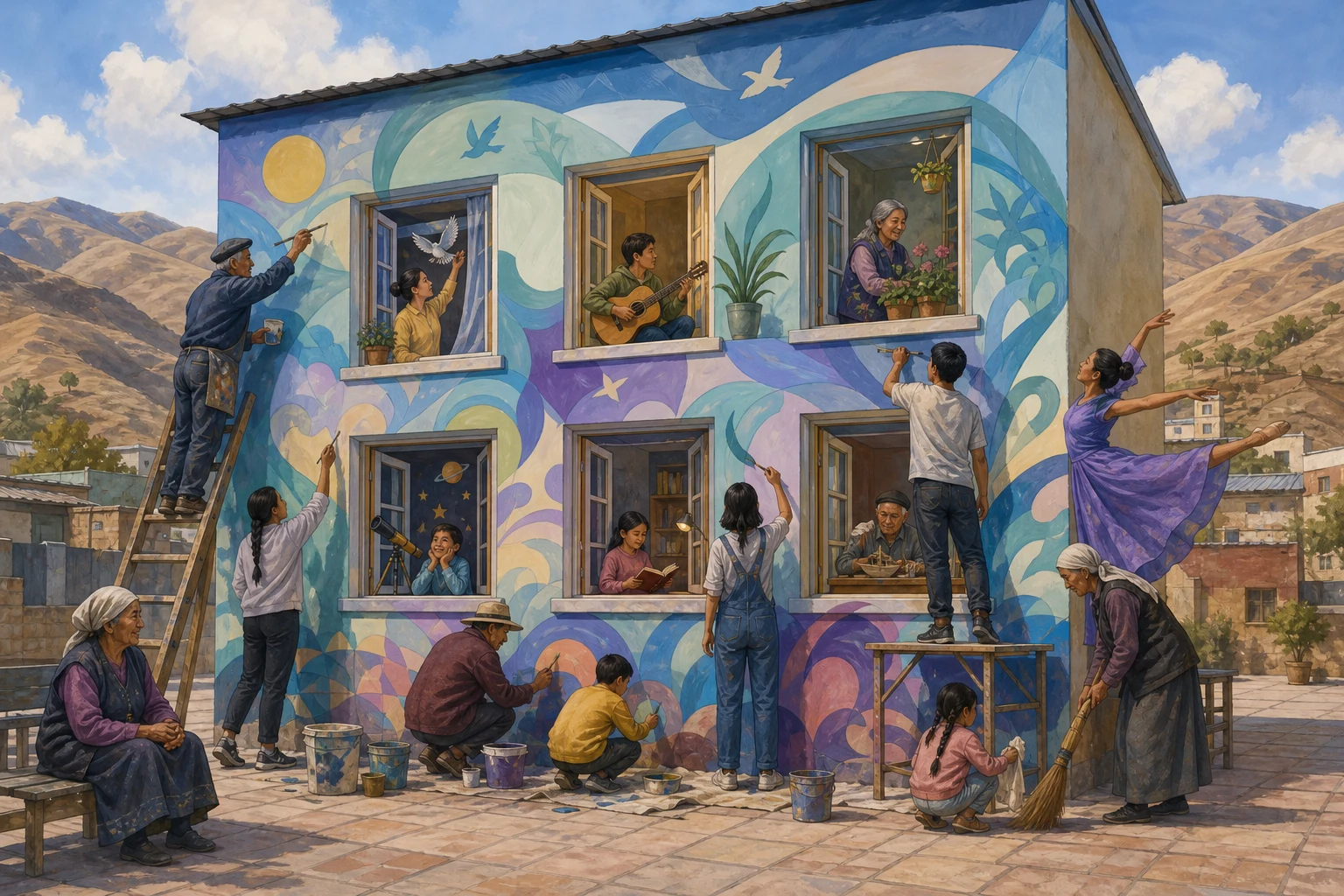
Leave One Window Open
Daro had brought six old photographs, three sharpened pencils, and a plan that left no space for anyone else.
Read Story →