
Quote Stories
What Hands Remember
A bookbinder discovers that repair is also a way of making room.

The kiosk arrived on a Tuesday morning, bright as a refrigerator and twice as smug.
Tessa watched two men wheel it into the covered market while she held a bone folder above a torn atlas. The machine’s screen lit up with a cheerful blue greeting. Nearby, the old market roof clicked and sighed in the rain.
By noon, a printed notice had appeared beside her stall: SELF-SERVICE BOOK AND OBJECT REPAIR, OPENING SOON.
Tessa read it three times. Then she returned to the atlas and pressed its pages flat.
For eleven years, she had repaired books in the market’s narrowest aisle. She could resew a broken binding, replace a spine, and match faded cloth so neatly that customers sometimes forgot where the damage had been. But the kiosk promised speed. It promised convenience. It promised not to ask anyone to wait while glue dried.
That evening, Tessa pinned up her own notice.
LEARN TO REPAIR WHAT YOU KEEP.
The first class filled quickly. People brought a loose button, a cracked frame, a child’s music book, and a wooden box with a hinge that squeaked like a mouse. Tessa arranged tools on the long counter and explained each step.
“Not that way,” she said when a student held the awl too close to the edge.
“Use less glue.”
“Your thread is crossing.”
By the end of the hour, the button had vanished, the frame leaned at a worrying angle, and the music book had acquired a blue smear across its cover.
Tessa repaired everything herself after the students left.
The second class was smaller. The third had only two people, one of whom spent most of the time pretending to study the market ceiling.
“You don’t teach,” said Arun, the owner of the tea counter. “You interrupt.”
“I prevent mistakes.”
“Sometimes a mistake is the only way to find out what someone is trying to do.”
Tessa disliked this because it sounded wise, and wisdom was difficult to sand smooth.
A week later, a child came to the stall carrying a recipe book wrapped in a yellow scarf. She was perhaps eight, with two uneven braids and flour on one sleeve.
“My grandmother says you can fix it,” the child said.
The book had been used so often that its cover had separated from the pages. Some recipes were written in pencil, some in ink, and one page had a brown crescent where a bowl of soup had spilled years ago. Between the instructions were notes in several hands: less salt, wait until the onions soften, ask Mira before changing this.
“What’s your name?” Tessa asked.
“Lina. I want to repair it before Saturday.”
“Why Saturday?”
“My grandmother is teaching everyone her bread.” Lina placed the book on the counter. “But she says the recipe is in the wrong order now.”
Tessa opened the book carefully. The sewing had failed in three places. She could restore it, but the pages would still be loose unless someone decided how they belonged.
“I can do this,” she said. Then she looked at Lina. “Or you can help.”
Lina climbed onto the stool.
Tessa showed her how to lift the old thread without tearing the paper. Lina worked slowly. Twice, she made a hole in the wrong place. Tessa felt the familiar urge to take over. Instead, she asked, “What do you think happened?”
Lina studied the pages. “This one was added later. My uncle writes very small. Maybe he wanted it near the beginning.”
“Where would you put it?”
Lina rearranged the sections. She placed the bread recipe beside the notes about warming the oven, then tucked the family comments into a pocket made from folded cloth.
“It doesn’t look like mine,” Tessa said.
“It isn’t yours.”
The answer was so plain that Tessa laughed.
On Saturday, Lina returned with her grandmother and three neighbors. They opened the repaired book on the market counter and began arguing cheerfully about yeast. One woman brought a jacket with a missing button. Another carried a picture frame. Arun arrived with the squeaking wooden box.
Tessa put out the tools but did not arrange them by difficulty. She let people choose.
The market grew noisy. Someone threaded a needle backward. Someone else used too much glue. The frame became slightly more crooked before becoming sound. Tessa moved among them, asking questions instead of snatching objects away.
The kiosk opened the following Monday. It repaired simple tears quickly and printed tidy receipts. Some customers used it. Others still came to Tessa, bringing things that required decisions: a book with a child’s drawing in the margin, a coat whose button had been replaced three times, a box whose owner wanted to keep the squeak.
By spring, Tessa’s stall had gained a second counter. On its shelves stood jars of thread, scraps of cloth, spare hinges, and a growing stack of handwritten instructions.
At the top of the stack, Lina had written: ASK WHAT IT WAS LIKE BEFORE.
Tessa left the note there. It was not the neatest instruction in the collection, but it was one she had finally learned how to follow.
Related Quote Stories
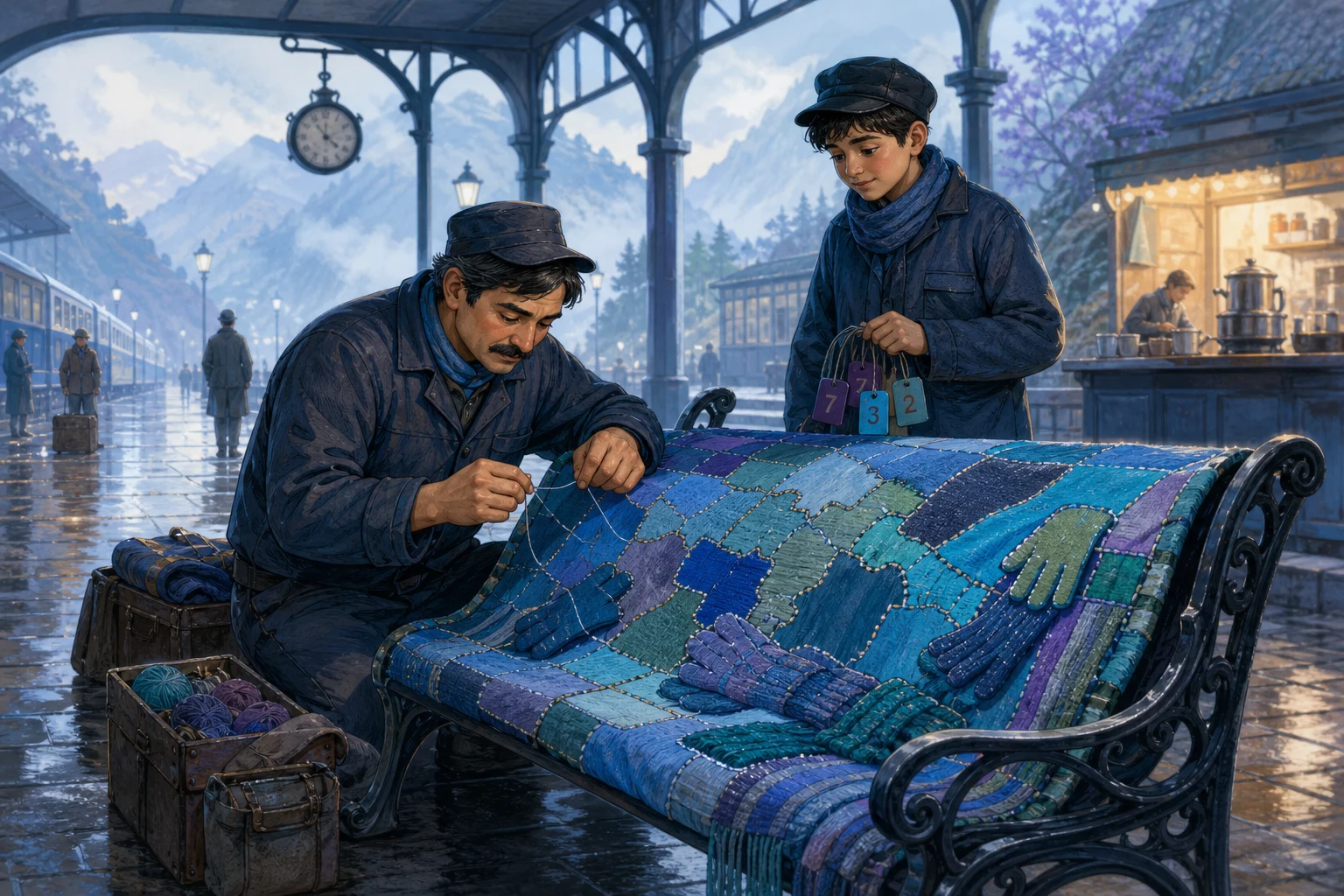
A Map Woven in Blue
Ilya’s patchwork bench covers began with lost gloves and ended as a map everyone could help complete.
Read Story →
Tabs in the Wind
Kito’s first calendar was neat, accurate, and almost useless. The second one belonged to everyone.
Read Story →
Where the Shade Falls
Tomas had already measured the orchard for sale when three young workers asked whether they could borrow it for one afternoon.
Read Story →