
Quote Stories
What the Pantry Could Say
Celia learns that a welcoming table needs more than a perfect menu.
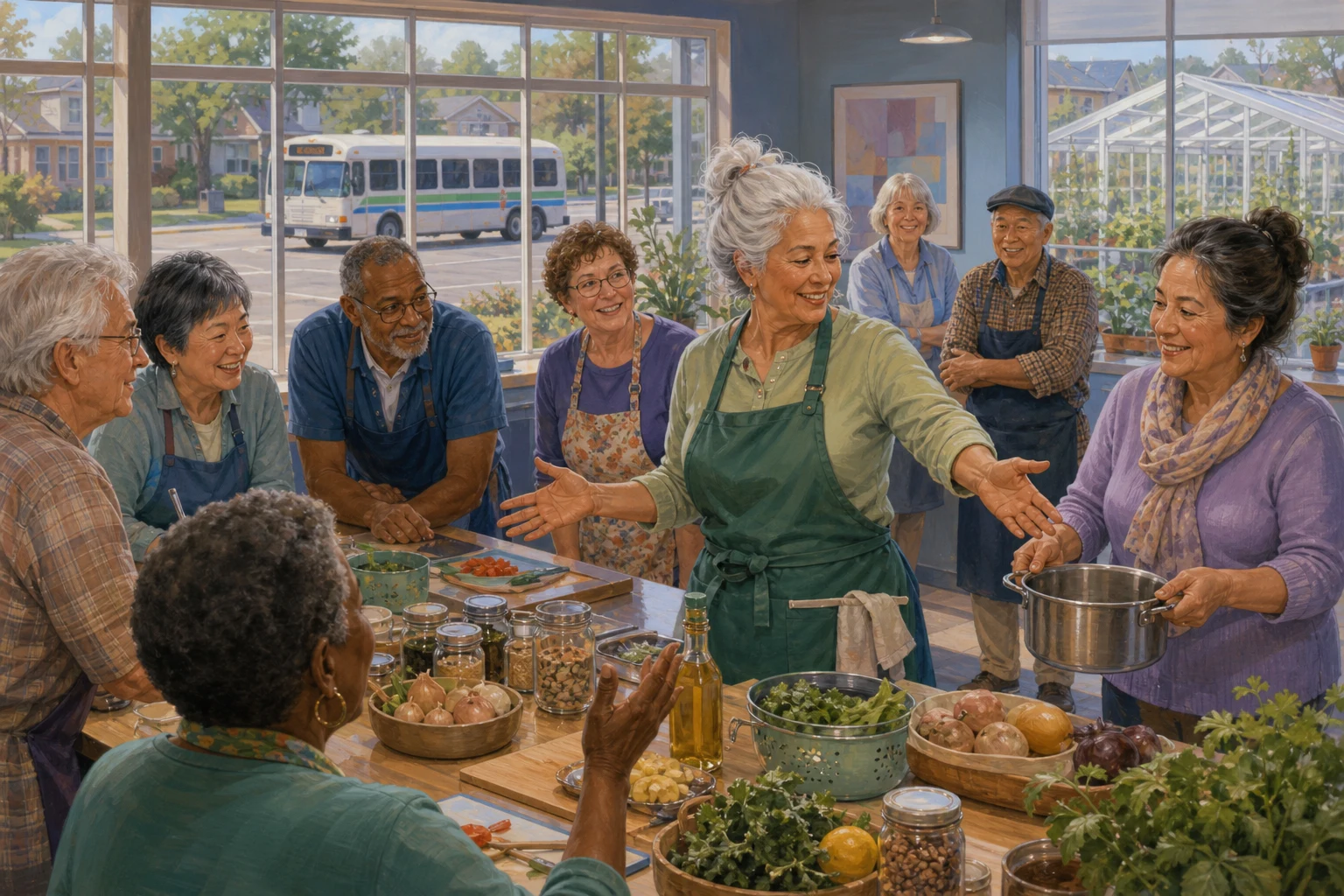
Celia’s first cooking class began with a sauce that required three pans, a thermometer, and the patience of a saint.
She had written the recipe in neat blue ink and taped it to the multipurpose room’s whiteboard. Beside it, she had placed a photograph of the finished dish: a glossy little tower of vegetables beneath a delicate fan of pastry.
“Hotel food,” she announced, tying her green apron. “Elegant, but achievable.”
Across the room, six residents stared at the ingredients. One quietly counted the eggs. Another examined the price of saffron. By the following week, only three people came back. By the third, Celia was teaching an empty room while a pot of expensive stock cooled on the stove.
She blamed the weather, then the bus schedule, then the room’s unreliable heating. Finally, she blamed herself—but only in the practical way she blamed herself for a crooked tablecloth. She would fix the program. She would make it better.
That afternoon, Celia carried the untouched stock to the communal greenhouse, where she found Noor clipping yellow leaves from the tomato plants.
“I’m beginning to think people don’t appreciate refinement,” Celia said.
Noor glanced at the stock. “People appreciate dinner.”
The remark annoyed Celia enough to make her laugh.
Instead of preparing another menu, she knocked on doors. She asked what residents cooked when they were tired, what they had learned from parents or neighbors, and what tools they actually owned. She discovered that Armand had no oven but made excellent bean fritters in a skillet. Lidia could not eat dairy and missed the lentil soup her aunt made. Tomas kept a jar of pickled peppers beside nearly everything. Mei measured ingredients by sight because her reading glasses were always disappearing.
Celia wrote it all down—not as corrections, but as instructions.
The next class began with a table covered in onions, canned tomatoes, rice, beans, herbs, and three kinds of pepper. There was no photograph on the board. Instead, Celia had written one question: What can this become?
Armand showed the group how to listen for the change in a sizzling onion. Lidia suggested coconut milk in place of cream. Tomas passed around his peppers, warning everyone that the smallest ones were the boldest. Mei tasted the pot, added salt, and refused to explain how she knew it needed exactly that much.
Celia watched, hands folded behind her back. Several times she nearly intervened. The knife cuts were uneven. The rice had been added too early. Someone had placed the ladle on the clean towel.
Then Noor tasted the finished stew and nodded.
“This tastes like a place people can stay,” she said.
Celia looked at the crowded table. The dish was inexpensive, untidy, and better than anything she had planned.
A new resident named June had been watching from the hallway for two weeks. She never entered the room, even when Celia invited her. One evening, June shook her head before Celia could ask.
“I’m not joining a club,” she said. “I’m still sorting out my own kitchen.”
Celia understood more than she expected. She packed a container of stew, added a card listing every ingredient, and left it outside June’s door. On the card, she wrote: No club required. If you ever want to change the recipe, we’d like to know how.
The following week, June returned the container. It was empty. Tucked inside was a note: Too much pepper. Good idea otherwise.
Celia pinned the note to the whiteboard.
At the next class, June appeared carrying a small saucepan. She showed them how to soften the peppers before adding them, and Armand asked whether the method would work with beans. Lidia offered to try. Mei reached for a pencil.
Celia tied on her green apron and moved to the end of the table, making room for someone else to stand beside the stove.
The class still had rules. Wash your hands. Label allergens. Let the person holding the knife finish. But perfection was no longer among them.
By spring, residents were bringing recipes that fit their own cupboards, memories, and lives. Some dishes were polished. Some were improvised. All of them had a place.
Celia kept her old hotel recipes in a folder beneath the counter. She had not abandoned them. She had simply stopped using them as invitations that guests had to earn.
Now, when someone asked what made the cooking class special, she pointed to the shelves of mismatched bowls and said, “Everyone gets to add something.”
Related Quote Stories

After the Last Train
Oren thought belonging could be organized with a stamp, a schedule, and a modest discount. Then a crowded food night taught him to leave room for strangers to become hosts.
Read Story →
Keep the Kites Close
Ema wants to rescue her town’s kite festival with one daring flight. Instead, listening to her neighbors leads her toward a celebration that belongs to everyone.
Read Story →
A Pocketful of Repairs
When a delivery rider brings Mara a jacket held together by mismatched buttons, the retiring tailor begins one last project: teaching the whole district how to mend what still has life in it.
Read Story →