
Quote Stories
When the Marsh Began to Ring
Edda listens for a new purpose in an old craft.

Edda’s first warning bell vanished into the reeds.
She stood on the dock with one hand still resting on its warm bronze rim, waiting for the note to return. Instead, the marsh answered with frogs, oarlocks, and the soft knocking of canoe poles against wood.
“That one is beautiful,” said Lio, who guided morning canoe trips along the narrow channels. “It’s just not loud enough to keep two boats from meeting in the fog.”
Edda looked toward the workshop behind her. For forty years, its shelves had held harbor bells in three sizes, each made from the same dependable mold. She had planned to close the shop at the end of the month. The molds would go to a metalworker inland. The sign would come down. Her hands, she had decided, had made their last bell.
“Then you need a louder bell,” she said.
“We need one we can hear,” Lio replied. “The marsh is not the harbor.”
Edda disliked the distinction. A bell was a bell. A good bell had a clear voice, a steady decay, and no unnecessary fuss.
Still, she agreed to try again.
Her second bell was larger. Fishers tested it from the far footbridge. It sounded strong near the workshop and disappeared beyond the salt grass. A third bell carried farther, but its low note blended with the wind. A fourth rang so sharply that the birdwatchers complained it scattered the herons.
At last Edda placed a folding table beside the canoe shed and wrote three questions on a slate: Where did you hear it? What did it cover? What did it make you notice?
Fishers marked the places where fog gathered thickest. Birdwatchers described the calls they did not want drowned out. Children ran along the boardwalk, tapping spoons against pots, shells, and pieces of driftwood. Even the ferry cook contributed a cracked teacup that produced a surprisingly gentle chime.
Edda listened, though not always patiently.
“No one makes a bell by committee,” she muttered one afternoon.
“Maybe not,” said Lio. “But everyone hears one differently.”
That evening, Edda reopened a drawer she had not touched in years. Inside lay scraps of old experiments: a thin strip of copper, a dented clapper, a mold with an uneven lip. She had kept them because they were failures. Now she wondered whether they had simply been waiting for a better question.
She changed the shape of the bell’s mouth. She lightened the clapper. She added a narrow ring inside the bronze, not to make the note louder, but to give it a second tone beneath the first.
The new bell sounded modest in her workshop. At the end of the boardwalk, however, the high note traveled over the reeds while the lower note stayed near the water. Two boats could hear it without mistaking it for a birdcall or a gust through the grass.
Edda made five more, each with a different voice: one for the bend near the eel traps, one for the crossing beside the heron flats, and three for the canoe routes where morning fog arrived earliest.
On the first testing day, she handed the smallest bell to a girl named Sella, who had been tapping spoons since the beginning.
“Why me?” Sella asked.
“Because you noticed the teacup,” Edda said. “That is useful.”
Sella struck the bell. Its note moved across the marsh, followed by the soft answering calls of unseen birds.
No one spoke for a moment. Then the fishers began pointing out places where the sound changed. The children adjusted the bells’ heights. Lio sketched a route map. Edda took notes in a book that had once been reserved for orders.
When the fog lifted, the marsh seemed larger than it had that morning. The bells had not silenced it. They had given people a way to move carefully through its many voices.
At the end of the month, Edda did not take down the workshop sign. She did remove the old price list from the window. In its place she hung a handwritten notice:
Bells made to be heard together.
The next morning, Sella arrived before sunrise with a question about molds. Edda unlocked the door and moved three finished harbor bells aside to make room at the workbench.
Outside, the first canoe passed through the mist. A clear note rose over the reeds, and a lower one followed, steady as a hand held out in greeting.
Related Quote Stories
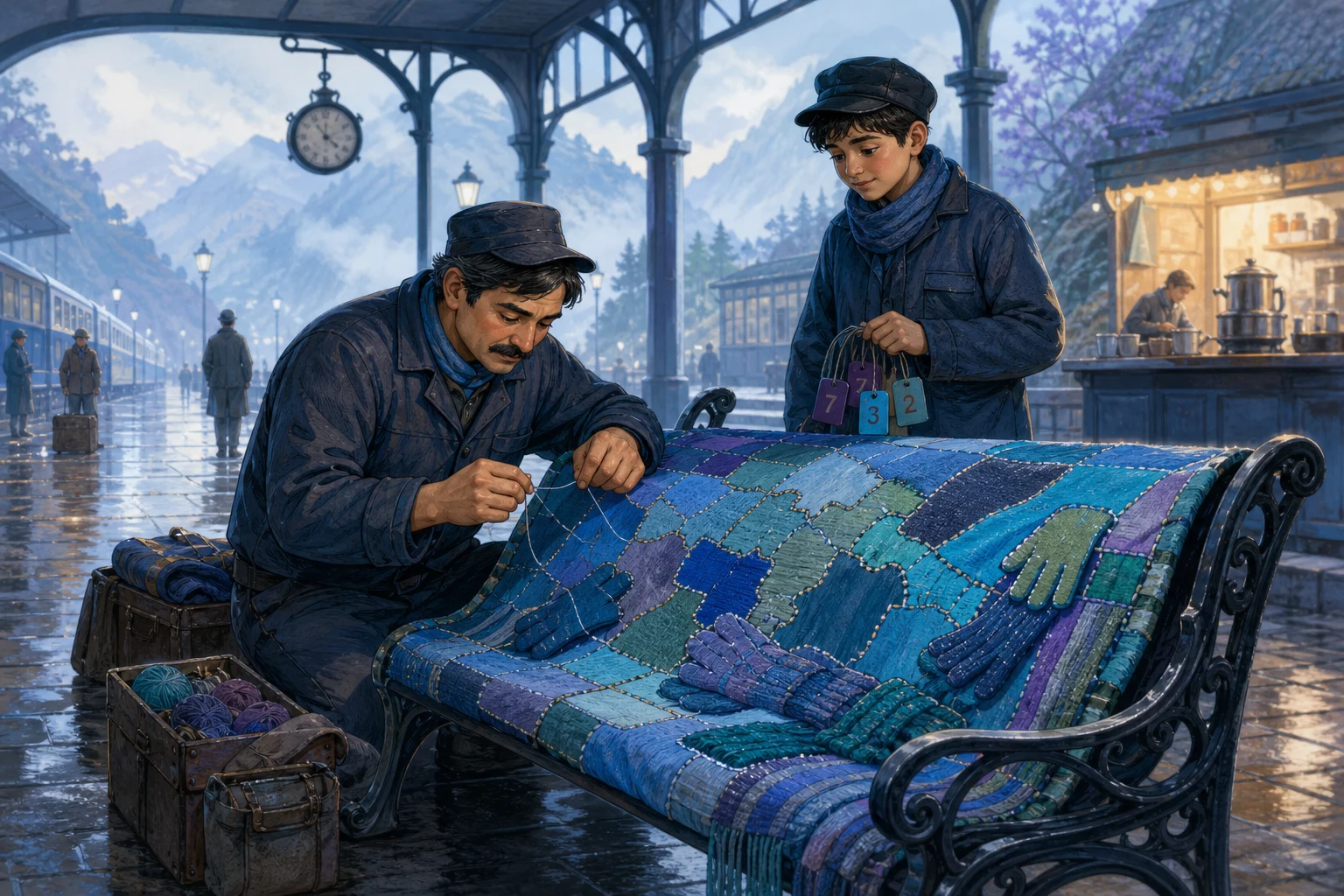
A Map Woven in Blue
Ilya’s patchwork bench covers began with lost gloves and ended as a map everyone could help complete.
Read Story →
Tabs in the Wind
Kito’s first calendar was neat, accurate, and almost useless. The second one belonged to everyone.
Read Story →
Where the Shade Falls
Tomas had already measured the orchard for sale when three young workers asked whether they could borrow it for one afternoon.
Read Story →