
Quote Stories
Where the Grain Dust Settled
A cabinetmaker learns to look twice

By the third Thursday, Noor had moved the blue carpenter’s square away from the edge of the bench six times.
“Tools stay where you leave them,” she said.
Mara, the grocery clerk, nodded and put it back exactly where she had found it.
The evening class met in the old rail depot, where wind slipped beneath the doors and grain dust gathered in the corners. Six adults came after work to learn the patient grammar of wood: measure, mark, cut, fit. Noor, sixty-two and narrow-shouldered, could read a warped board at a glance. She had built cupboards that outlasted families and tables polished smooth by generations of elbows.
She also knew, almost immediately, who would be good.
Tomas cut clean miters. Leena understood grain direction. Arun asked sharp questions and remembered every answer. Noor quietly reserved the wide bench beneath the best lamp for whichever of them arrived first.
Mara was given the bench by the drafty window.
She made small errors. Her pencil marks wandered. She held the chisel too lightly, then too hard. Once, she fitted two pieces together backward and stared at them for so long that Noor assumed she was embarrassed.
“Take it apart,” Noor said.
“I’m trying to see why it wants to stay this way.”
Noor almost laughed. “Wood doesn’t want anything.”
Mara turned the pieces over. “Then I suppose I’m the one being stubborn.”
The class was interrupted the following week by a request from the community center. Its new reading room needed furniture before winter: low shelves, sturdy stools, a reading table, and a cart for moving books between rooms. The director offered the learners a challenge. Each person could design one piece around a memory of being welcomed somewhere.
Noor assigned the shelves to Tomas, the stools to Leena, and the table to Arun. She gave Mara the cart.
“A cart is mostly wheels,” Mara said.
“And handles,” Noor replied. “You’ll manage.”
Mara brought in a drawing covered with arrows, erasures, and measurements that did not agree with one another. The cart had a broad lower shelf, a narrow upper ledge, and handles that curved inward.
“It’s awkward,” Noor said.
“It’s for books and children.”
“Children are not a measurement.”
“They are if you’re trying to stop books from falling on them.”
Noor looked again. The low shelf was deep enough for picture books. The upper ledge could hold books being returned. The inward handles left a clear path through a crowded room. Mara had even added a small rail along the back, so a book could lean there without sliding off.
Still, the joints were uneven.
For two evenings, Noor corrected them without comment. On the third, she found Mara sanding the same corner.
“You’re removing too much,” Noor said.
“I know.”
“Then why continue?”
Mara ran her thumb over the edge. “At the grocery, I used to stock the lower shelves. People with canes could reach them. Parents could keep one hand on a child. Nobody praised the arrangement. They just found what they needed.”
Noor sat on the overturned bucket beside her.
Mara continued sanding. “My grandfather had a reading room in his apartment. One shelf was always crooked, but it held the books everyone wanted. I think I remember the shelf more than the books.”
The next night, Noor moved the blue square to Mara’s bench.
“Why?” Mara asked.
“Because you keep putting it back.”
They worked side by side. Noor showed Mara how to loosen a joint without splitting the wood. Mara showed Noor how the cart could turn inside the reading room’s narrow doorway. Together they shifted the handles, lowered the center of gravity, and added a brake made from a simple wooden peg.
On opening day, the shelves stood straight beneath the windows. The table bore small knots that Arun had chosen to leave visible. Leena’s stools were different heights, so children and adults could sit comfortably. Mara’s cart looked plain beside them.
Then the room filled.
A boy pushed the cart toward the picture-book corner. An older woman used it to carry a stack of large-print novels. Two children leaned on the handles while choosing books, and the cart did not tip. When the room grew crowded, Mara guided it neatly between the chairs and parked it without blocking the door.
Noor watched from beside the coat rack.
“Practical,” Tomas admitted.
“More than practical,” Noor said.
Mara returned with an empty cart. “The brake catches a little.”
“It catches exactly enough.”
Outside, evening wind moved across the prairie and lifted pale dust from the road. Inside, the cart waited beneath the reading-room lamp, its shelves ready for another journey.
Noor handed Mara the blue carpenter’s square.
“Keep it,” she said. “You notice things the rest of us walk past.”
Related Quote Stories

When Desks Learned to Bend
Nera’s first folding desk collapsed under the weight of a single book. Hiding the failure would be easy; inviting others to inspect it would be harder—and far more useful.
Read Story →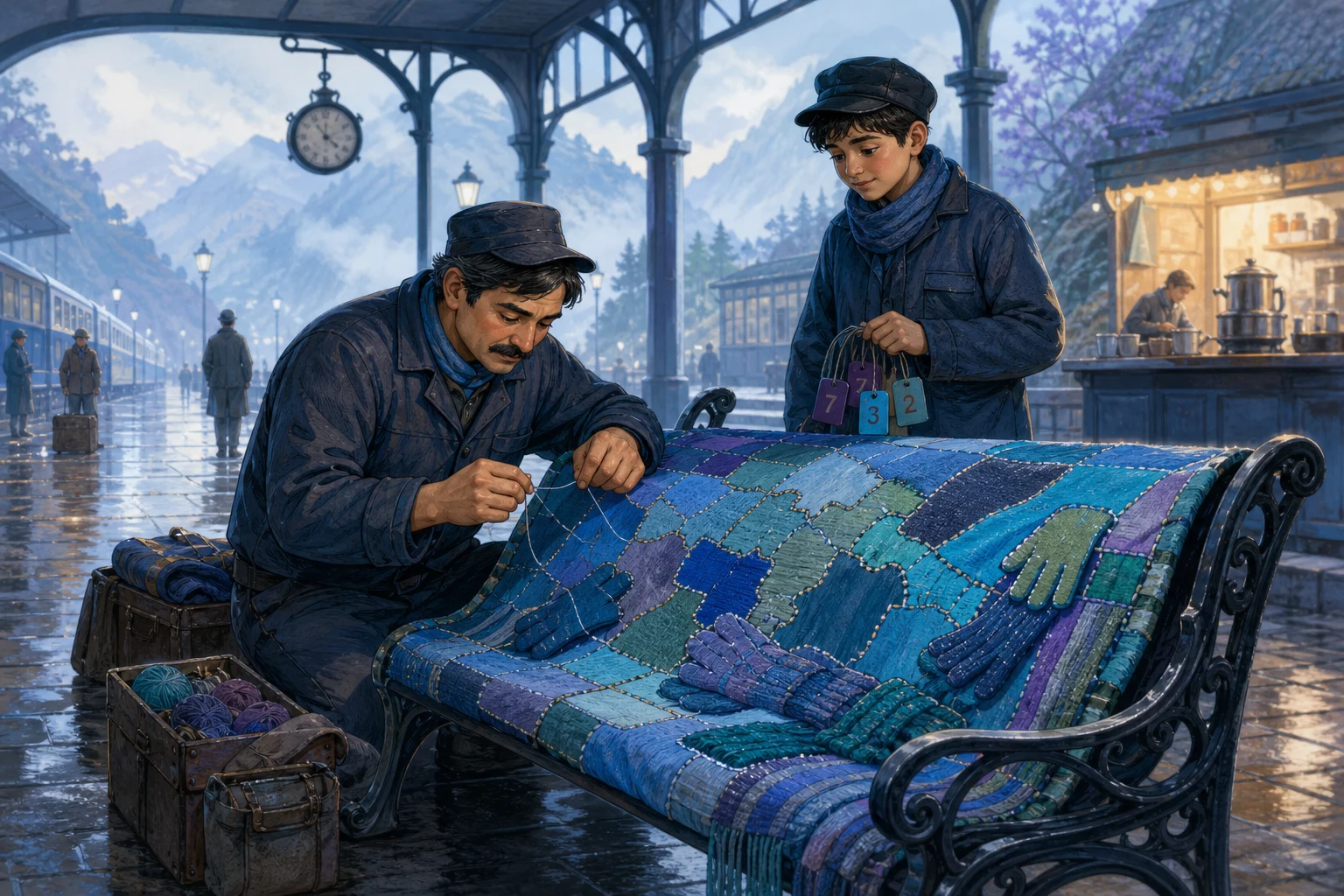
A Map Woven in Blue
Ilya’s patchwork bench covers began with lost gloves and ended as a map everyone could help complete.
Read Story →
Where the Shade Falls
Tomas had already measured the orchard for sale when three young workers asked whether they could borrow it for one afternoon.
Read Story →